Artificial intelligence is moving at extraordinary speed, leaving technology leaders with a growing list of decisions about where to invest, what to build and how quickly to move on. Capitec Bank group CIO Andrew Baker cut through the noise to explore what it takes to navigate AI from an IT leadership perspective.
Telepathy is a phenomenon that is confined to the realm of science fiction. Capitec Bank group chief technology officer Andrew Baker lifted the veil on some of the ground-breaking AI innovations that the bank has implemented that are not only pioneering and somewhat ethereal, but have meaningfully enriched customer experience.
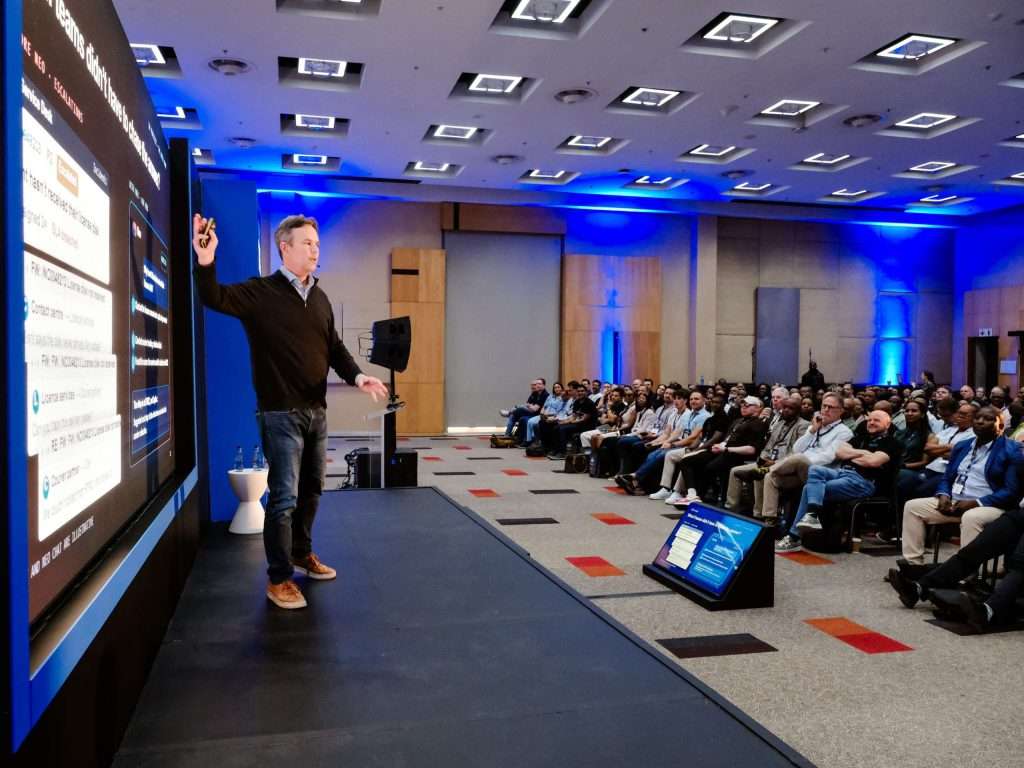
Andrew took delegates through Capitec’s AI journey at the 2026 IT Indaba, which took place at the Sandton Convention Centre, in a masterclass titled: Navigating AI: A masterclass on cutting through the hype to build what matters.
Andrew explained that one of the challenges that Capitec was facing was a plethora of debilitating system downtimes that negatively affected customer experience and hampered clients from using the bank’s services and apps.
How it all began
He said Capitec’s AI journey was “not a natural AI story” but was largely driven by a massive outage which he refers to as “an intergalactic outage” that rocked the bank four years ago – it lasted for about 40 hours.
“In an effective company a bad moment like this marks the time for reflection where people say: This is not good enough, what then? This moment marked the beginning of our AI journey, but we just didn’t know that at the time,” Andrew recalled.
He said at the time most of the bank’s data sat on legacy systems like Windows, sequel servers, and a mainframe. His team re-platformed the entire system. The bank broke apart capital into little pieces and product domains in a painstaking process that lasted several years. “The outage was a very prevalent memory while we were doing this so there was a lot of anxiety about what we were going to create. It really hurts when you experience these outages affecting approximately 26 million customers,” he said.
Andrew said the bank deployed a platform called Backstage to mitigate against these outages. Capitec had between 123 and 20 AWS services that they vented. He said they took a lot of decisioning overheads and just asked contextual questions which, in the process, created something that was fundamentally scalable.
To assess a return on this substantial investment, Andrew said they measured impact using several variables including down detector and observability layers. “One thing we are really good at is measuring downtime. So, this is our downtime: in 2022 we registered 121 hours of downtime. This wasn’t a ‘good downtime’. It happened on a Friday, on a payday at the petrol station. It was an ugly downtime. After we fixed these issues, our downtime decreased to 39 hours in 2023, 8 hours in 2024, 9 hours in 2025 and 14 minutes in 2026. We are proud of that, it feels good,” Andrew said.
Innovation on steroids
With the downtimes under control, Andrew said this freed up time, which approximated to between 60 and 70 percent of available time, for the team to be innovative and productive. “In the past we could not do product development as we wished to because we were managing crises all the time, apologising, dealing with support, it was not a good space for us. This is the most productive we have ever been,” he said.
Buoyed by the success of Backstage, Capitec implemented several cutting-edge innovations such as an agentic AI application called Pulse that provides the consultants with the client’s full picture before the call is even answered. It does so when the call is routed through the call centre where the client is identified by their phone number or in-app which then allows the consultant to proactively detect any challenges the customer may have encountered on their account. Andrew said the implementation of Pulse has lowered handling times by 15 percent and resulted in a 26 percent net performance improvement.
“I went to the call centre the day it went live. Someone screamed, literally screamed and exclaimed: ‘How did you know that?’ It can be very creepy, but it cuts down back-and-forth conversations. There is no confidential information about the client that is kept, that’s the reason we call it Pulse because it lives for a second and we don’t use it for marketing. The system is there to help you and to stop you from getting frustrated,” said Andrew.
Hot on the heels of the resounding success of Pulse, Andrew revealed that they launched an agentic AI platform called Bhekani that joins every incident call and alerts engineers about what is wrong. The AI application investigates, rules out, and explains the cause of the incident. To protect their clients from scams and cyber breaches, Andrew said Capitec also launched a Scam Checker that checks suspicious links, texts and screenshots and explains the risk in plain language.
Andrew advised organisations to base their AI strategy on four pillars, namely fixing the foundation first before any AI application is integrated into the processes. Secondly, ensuring that the IT and network infrastructure is safe for AI implementation, thirdly, deploying AI to start addressing a specific problem and, lastly, guarding the data and keeping a hawk-eye on costs.