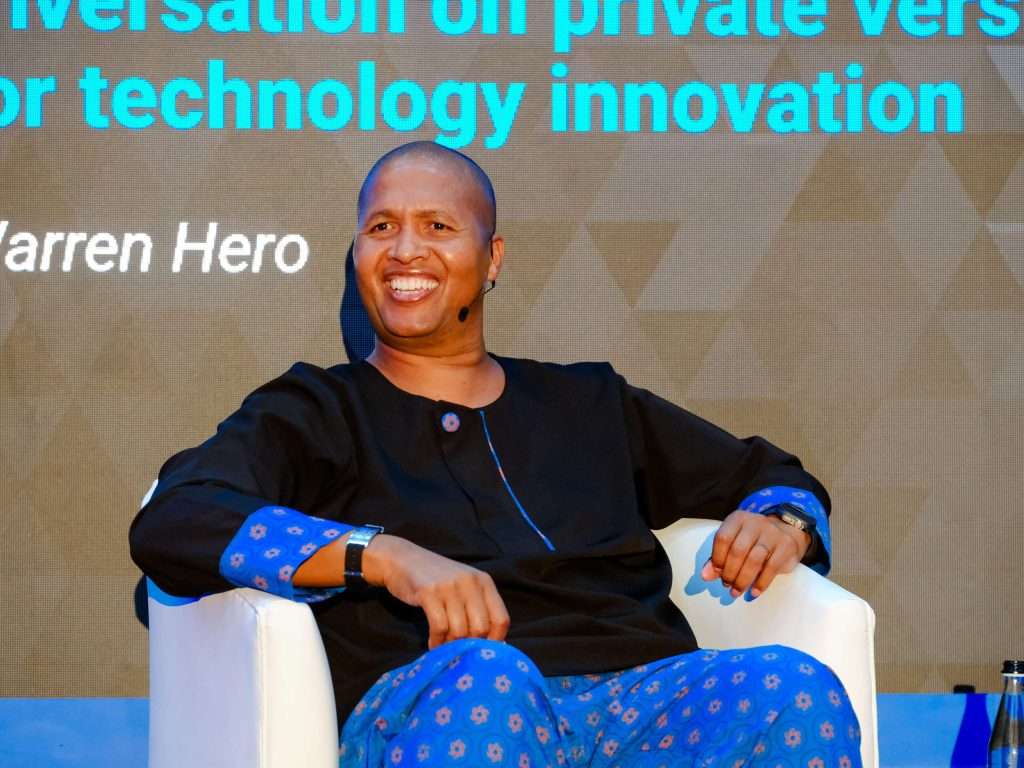
During the panel discussion that took place on 21 October, Sars design segment product lead, Warren Hero highlighted that private companies are often seen as more agile. But he says public and private organisations face very similar hurdles when they modernise.
For Sars’ Warren Hero, digital change depends less on process and more on empathy, a clear purpose and human connection.
Warren said one principle has guided his leadership across every role: “First of all, it is all about people and throughout my career, there is this mantra that I always come back to: ‘with people, fast is slow, and slow is fast’. When you take your time to understand people’s aspirations, it is a great starting point,” he said.
He also insists that his management teams set aside time to think, so that they do not simply react under pressure. “I ask my team: where is your thinking time? Where is your time for reflection? Where is your time where you spend thinking about your business? Synthesis is the antidote to complexity. When we do not take time, ideas do not have enough opportunity to synthesise,” said Warren.
Design from the outside in
To make public services work, Warren advocates an outside-in approach. Instead of making citizens navigate rigid internal procedures, leaders should look at the task the customer is trying to complete and work backwards to remove friction.
“It is only good enough once there is no friction for our teams or for the customer,” he said. “When we redid the Sars strategy, we thought about the singular design principle that would inspire trust but also decrease friction: no service is the best service, because you do not get up wanting to do your tax.”
This approach has produced results at Sars, where 6.8 million citizens received automated tax assessments. Of these, 99.3 percent accepted the pre-completed declarations and 98 percent received their refunds within three days.
Start with the early adopters
Warren cautioned against trying to win over the loudest objectors first when leading change. He suggested building momentum with the people who are naturally open to new ideas.
“If there are 100 people in the organisation, I need 16 people, the innovators and early adopters who tend to have an orientation towards change. Once I have those 16, they become valuable in spreading your idea because they connect people across multiple cliques,” he said.
He also encouraged leaders to pay attention to the stories people tell, because these can show problems early.
“In complex systems, you often do not understand causality. Where do you start? You start with understanding the stories. A narrative often gives you early indicators of pathologies that exist in the system,” said Warren.
Purpose, play and potential
Warren believes the customer experience reflects the employee experience. He said three things drive engagement at work, and leaders should create the conditions for them rather than rely on instructions from the top.
“There are three things that promote engagement at work: purpose, play, and potential. Your responsibility as a leader is to create space and to facilitate someone finding their own connection to purpose,” he said.
He also pointed to the value of movement, saying that 22-minute walking meetings help teams move past defensive instincts.
“Walking hijacks your old brain and leaves your neocortex open to be expressive. Play is a productivity mechanism that allows you to really understand values and solve complex problems,” Warren concluded.