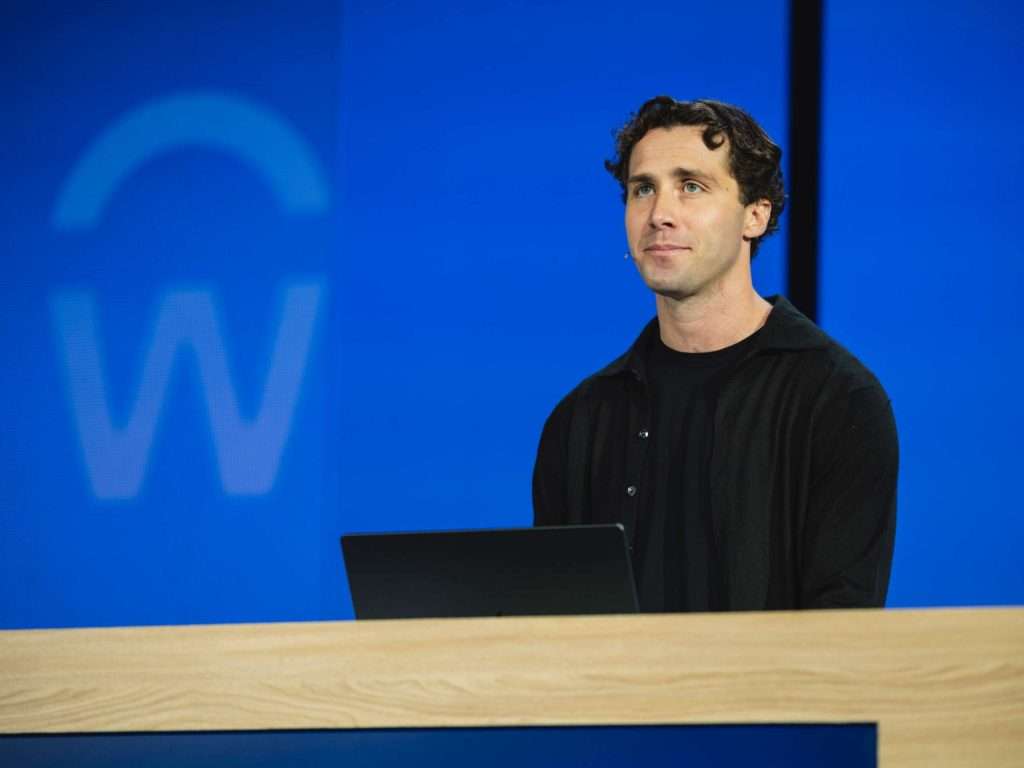
Workday chief AI officer Joel Hellermark explains why the future of enterprise technology lies in proactive, multiplayer AI across business teams.
The days of employees having to tell AI exactly what to do, one prompt at a time, could be numbered. At Workday Rising EMEA, Joel Hellermark, chief AI officer at Workday, made the case for a workplace where AI does not simply sit on the sidelines waiting for instructions, but gets stuck into the work itself.
According to Joel, the opportunity lies in closing the gap between what AI can already do and how people are using it. He believes organisations have yet to tap the full potential of these systems.
“The gap emerging among customers is the significant difference between what models are capable of and how users are actually prompting these systems. That diffusion gap represents a major opportunity, and it’s what we’re building towards,” he said.
No prompt, no problem
According to him, bridging that gap will require more than putting powerful technology in employees’ hands. Organisations also need the right support to identify opportunities, rethink processes and make AI useful in the realities of their businesses.
“We’re addressing this in part through forward-deployed engineering and by positioning our customer success organisation to be the best AI partner for companies. At the same time, we’re developing the product to be more proactive, increasingly capable of solving tasks end to end and autonomously,” said Joel.
“The idea is that agents shouldn’t have to wait for a prompt or be limited by the quality of the prompt they receive. Instead, users should be able to hand them real work, with agents proactively identifying and carrying out tasks they can automate. We believe this will significantly change the pattern of AI adoption,” he added.
Joel said customers are increasingly looking for ready-to-deploy solutions rather than having to piece together their own AI capabilities.
“We're very focused on our domains, but increasingly, I think those domains are also beginning to dissolve. What customers are asking us for is packaged AI solutions. They don't want to build everything themselves, from soup to nuts. They want something that has been thought through, is accurate, works and comes ready to deploy,” he explained.
“There will be very different forms of AI. The one we're particularly focused on is multiplayer AI – AI that works across multiple people, systems and processes.”
AI joins the team
As Joel puts it, this is where the distinction between an individual AI assistant and an agent embedded in a wider business process becomes important. Joel explained that multiplayer AI is designed to keep work moving between people, rather than simply helping one employee complete an isolated task.
“That architecture looks quite different from the single-player AI we're seeing across many of the tools currently available, where an individual operates a system to complete specific tasks. For example, a talent acquisition agent might support a process involving several people. One person conducts an interview, the agent captures the notes, pre-fills the relevant information and briefs the next person before passing it on to someone else for approval,” he explained.
“All that context needs to be shared, properly governed and supported by the right permissions. Multiplayer AI is therefore an area we're particularly focused on,” added Joel.
If organisations think they have figured out their AI adoption strategy, Joel's next point offers a reason to revisit the playbook. The technology is advancing so quickly that the ambition of today could look modest in just a few months.
“Model capabilities are fundamentally changing what you can achieve with AI every six months. If you had made this transition a year ago, you might have equipped everyone with a copilot to help them incrementally improve how they completed certain tasks. If you were making that transition today, you would approach it quite differently. You would probably identify a small set of tasks, perhaps those that take two to four hours to complete, and hand them over to agents to execute autonomously,” he said.
“Six months from now, you might be handing over tasks that take a full day or longer. Six months after that, agents could potentially work independently for months,” said Joel.
Joel sees this as something much bigger than a technology upgrade, describing a future in which the organisation itself is continually being reshaped.
“This is not just a refounding moment for many companies, but the beginning of an era of continuous refounding. In fact, I believe employees will spend much of their time pushing the limits of these systems, constantly re-engineering processes and handing over more and more work to agents,” he stated.