
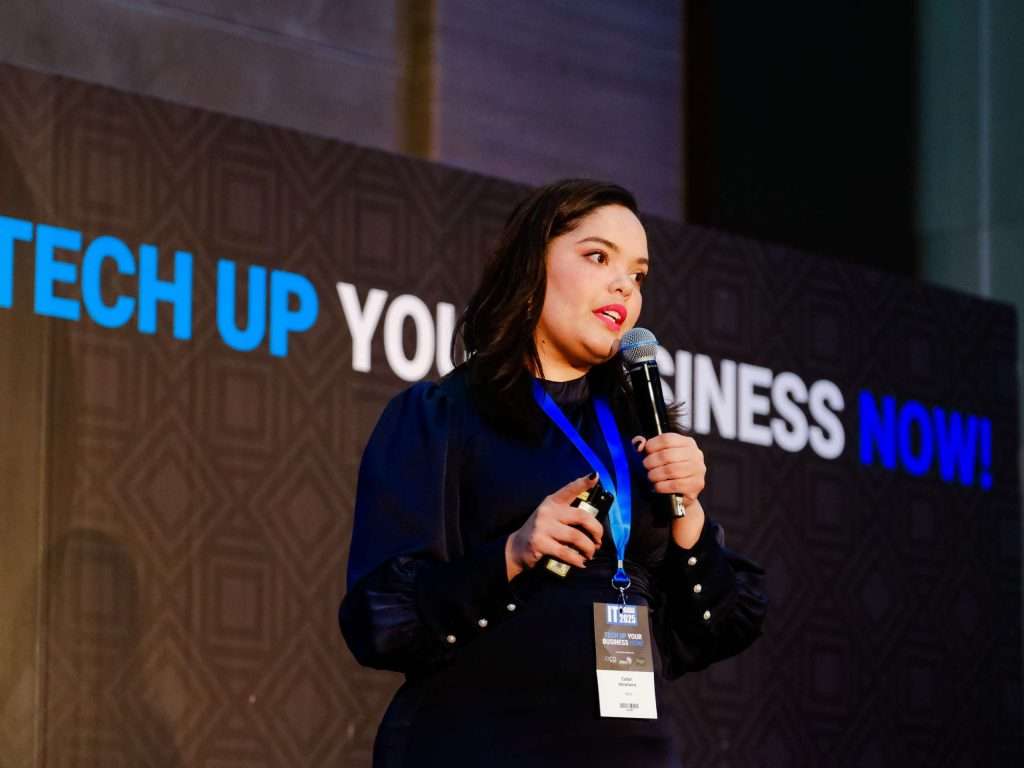
At the first-ever IT Indaba, Callan Abrahams, AI executive at iOCO, challenged South Africa’s tech community to think bigger. She framed her session themed The Data Journey of South Africa, as a call to action to not debate AI in abstract terms, but to apply it to real problems facing the country.
Drawing from her work, she addressed a misconception that South Africa is perpetually behind in technology. She argued that the challenge is not talent, but flawed systems.
“Many people blame politicians for our problems, but I’ve learnt something different. What my team and I have learnt is that it is in fact broken systems that allow for fraud, corruption, and mismanagement. People get away with things when systems don’t work,” she elaborated.
“The difference between a country like South Africa and some first-world countries where corruption is harder to get away with is the systems. As a systems thinker and builder, this is crucial. It all comes down to the data.”
She illustrated the transformative power of data with concrete examples, from detecting fraud to helping citizens access opportunities and improving municipal services. “This is impossible without the right data infrastructure,” she stated. “Too often, data is sitting in filing cabinets on paper, which makes it easy to lose, manipulate, or abuse. When everything is digitised and stored properly, that’s when we can build a future where corruption and fraud are harder to achieve.”
Callan then expanded the conversation to AI’s broader potential. She argued that AI’s value comes not from flashy implementations, but from meaningful solutions that improve lives.
Adding real value
“I’ve found that the most important factor in making AI and data work is navigating people challenges. AI today is the foundation for future infrastructure. It is about what you build with it and whether it adds real value to people. We can identify learning challenges in children early, detect potential corruption before it escalates, and improve services for citizens through it,” she said.
“For example, pensioners shouldn’t have to wait in the sun for hours to access their accounts. AI can fundamentally improve the value of public services in energy, education, public finance, health, safety and justice.”
To show the power of this accessibility and perspective, she cited a young mentee from the Cape Flats who developed an AI system with no formal training. “She built a system using AI to identify the safest route home. People experiencing challenges see problems differently, and AI can help solve these in ways we may never have imagined,” she added.
“To solve the impossible, we must start with empathy. We have to put ourselves in the shoes of those we’re building AI for. There is no perfect platform on day one. We need quick wins, rapid iteration and a culture of learning from failure. Building local capacity is essential, not just technical skills but resilience, the ability to push through challenges when it feels impossible. We can build systems that carry us into the future and create a better tomorrow.”