
South Africa’s top IT leaders gathered at The Leonardo in Sandton for a high-energy, interactive live survey that provided a pulse check on the future of technology leadership. From AI and cloud computing to IT’s evolving role in shaping the workplace, the survey explored the biggest trends, challenges and opportunities defining the next era of innovation.
Through the menti.com survey, executives shared real-time insights, strategies and bold predictions on how technology is transforming their organisations and industries. The results paint a compelling picture of where tech leadership is headed, and what it will take to stay ahead.
The IT professionals were presented with five questions, and these were the responses.
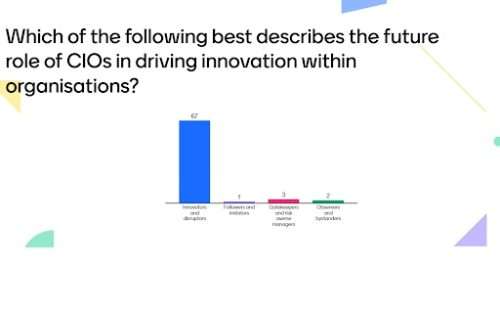
Which of the following best describes the future role of CIOs in driving innovation within organisations?
The survey results reveal a strikingly optimistic view of the future role of CIOs, with 67 percent of respondents identifying themselves as innovators and disruptors. In contrast, only a small percentage view future CIOs in more traditional or passive roles: just three percent see them as gatekeepers and risk-averse managers, two percent as observers and bystanders, and a mere one percent as followers and imitators.
“I played around with an AI platform myself and it had me thinking about what would happen to the trainers if they are replaced with AI,” said Keneilwe Gwabeni, CIO at Assupol.
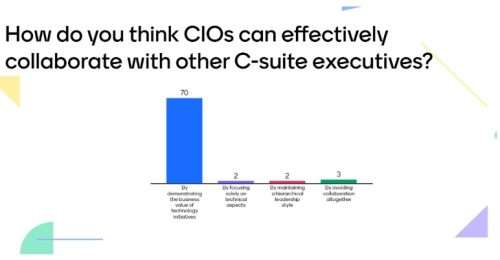
How do you think CIOs can effectively collaborate with other C-suite executives?
A clear consensus on the value of demonstrating the business impact of technology initiatives comes through in the survey results, with 70 percent of respondents considering this approach as the most effective form of collaboration with other C-suite executives. In comparison, a small minority hold different views: three percent prefer avoiding collaboration altogether, while two percent focus exclusively on technical aspects, and another two percent maintain a hierarchical approach to collaboration.
“Operational technology and IT will become more integrated, the IT department will become a fintech wing in the business, and generative AI will become embedded in the business – seeing CIOs integrating more seamlessly in the organisation,” added Sne Dlamini, VP: technology and digital at AECI.
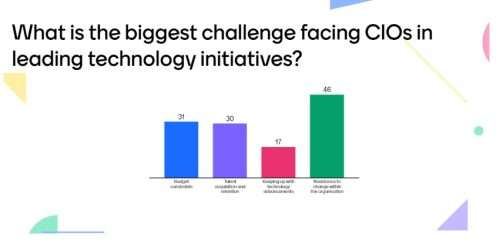
What is the biggest challenge facing CIOs in leading technology initiatives?
Resistance to change comes through in these survey results, with 46 percent of respondents highlighting this as the primary hurdle. Budget constraints also pose a notable challenge, affecting 31 percent of respondents. Then talent acquisition and retention emerge as another major concern, represented by a 30 percent result. Additionally, 17 percent attribute the stifling of technology initiatives to the struggle of keeping up with rapid technological advancements.
“Looking ahead, the only stumbling block I see is leading an ageing workforce, while your own role as a CIO also changes,” noted Viren Naidoo, CIO at Hollard Insurance.
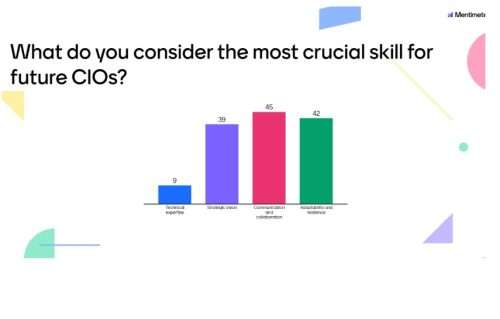
What do you consider the most crucial skill for future CIOs?
Forty-five percent of the survey respondents identified communication and collaboration as the most crucial competencies. Close behind, 42 percent believe adaptability and resilience are key, reflecting the need for leaders to remain flexible and thrive in an ever-evolving landscape. Interestingly, 39 percent emphasise the value of strategic vision, indicating that the ability to guide long-term growth remains vital. Meanwhile, only nine percent view technical expertise as a crucial skill.
“There is a need to upskill the technical knowledge of the board, especially for the non-tech-savvy members, and the need to use technology as an enabler for the business,” said Servesan Moodley, head of IT at Busamed.
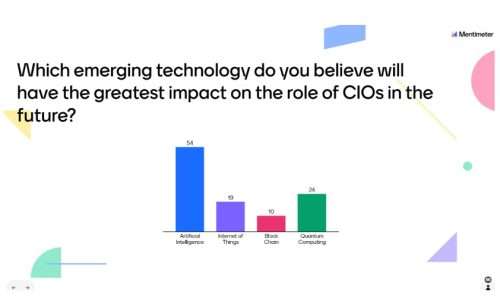
Which emerging technology do you believe will have the biggest impact on the role of CIOs in the future?
Enthusiasm surrounding AI comes through in the results, with 54 percent of respondents expressing significant interest in its potential. On the other hand, quantum computing has grabbed the attention of 24 percent of respondents. Meanwhile, the Internet of Things (IoT) is also viewed as impactful by 19 percent. Blockchain, however, garners the least interest, with only 10 percent predicting its future influence.
“Hyper-personalisation has become a big thing to the extent that we have moved from a traditional gaming platform to an omni-channel platform,” Pragasen Pather, CIO of Sun International concluded.