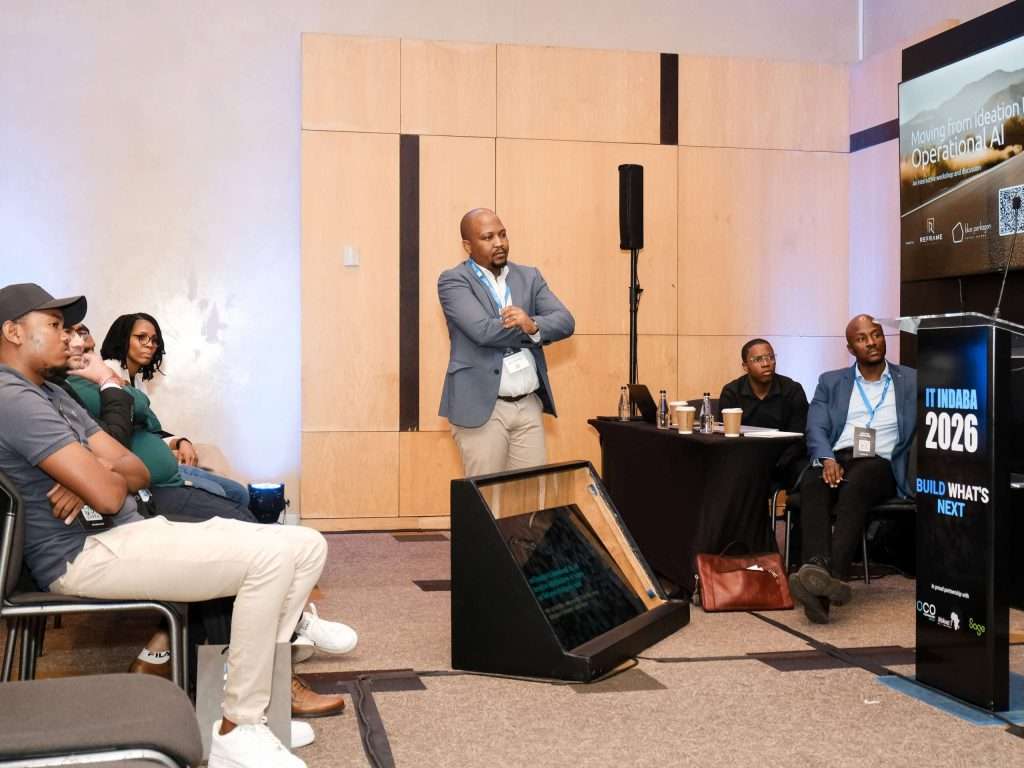
An interactive workshop at the 2026 IT Indaba explored how organisations can move AI prototypes into business operations, focusing on measurable value, governance, security and practical implementation.
Organisations are increasingly experimenting with AI, but turning prototypes into solutions that deliver business value remains a challenge, according to speakers at an interactive workshop at the 2026 IT Indaba, held at the Sandton Convention Centre in Johannesburg on 21 October.
The workshop, Moving from Ideation to Operational AI, brought together technology and business specialists to discuss how organisations can identify suitable AI use cases, establish measurable objectives and integrate solutions into existing business processes.
Facilitated by Aphiwe Bevu, managing director of Blue Pentagon Consulting and co-founder of Reframe Intelligence, and other industry specialists, the session explored the distinction between productivity-focused AI and operational AI, as well as the practical steps involved in implementing solutions.
Aphiwe said feedback gathered from attendees during registration highlighted interest in customer service, contact centres, workflow automation and operational visibility. Data access, data quality, security and return on investment were also identified as important considerations.
Defining business value before implementation
She said successful AI implementation starts with clearly defined business outcomes rather than selecting technology without an established purpose.
“The business needs to be clear about the outcomes it wants and articulate them in a way that enables technical teams to build something finite that delivers enterprise value,” she said.
She identified three challenges that can prevent organisations from achieving the expected returns on AI investments: unclear business objectives, inadequate measures of value and the gap between developing a pilot and deploying a solution.
Aphiwe also questioned the reliance on hours saved as a measure of AI success, noting that productivity gains do not automatically translate into improvements reflected in financial statements, customer outcomes or balance sheets.
“Organisations needed measures that connected AI initiatives to tangible business results and enabled executives to assess whether investments were delivering value,” she said.
Distinguishing productivity AI from operational AI
Mooketsi Gaboutloeloe, lead of business development at Altron Group, distinguished between productivity AI, which supports individual employees, and operational AI, which changes how business processes are performed.
He said organisations had made progress using tools such as copilots to improve individual productivity, but fewer had advanced towards embedding AI in their operations.
“Productivity AI is important, and we support it, but technology and business leaders need to push their organisations much further towards operational AI,” Mooketsi said.
He explained that operational AI requires different investment criteria and performance measures because it is applied to business processes where reliability, scale and the consequences of errors matter.
"We must be careful of relying on general-purpose AI tools for high-stakes operational tasks without considering inaccurate outputs and the controls required for business use,” he said.
Addressing trust and change management
Mekgwe Mfolo, co-founder of Reframe Intelligence, said resistance to AI adoption was often linked to employees' concerns about how the technology could affect their roles.
He said employees might be comfortable using AI to improve their own productivity but become more resistant when they believe it could replace their work or automate decisions they currently make.
“The challenge is less technical than political, because people do not trust what they do not understand,” Mekgwe said.
“Organisations needed to explain how AI would affect employees, provide education about the technology and communicate the opportunities it could create alongside potential changes to existing roles. Skills development could help employees prepare for new responsibilities arising from AI adoption, rather than viewing implementation only through the possibility of job reductions,” he said.
Using AI to accelerate software development
Tony Willis, AI solutions specialist at Altron Digital Business, demonstrated how AI-assisted development can accelerate the creation of software prototypes from business requirements.
Tony said he used a prompt in Claude Chat to generate an interactive HTML prototype for a loan application process in less than an hour. He subsequently adapted its appearance using a corporate colour palette.
He said these tools enabled business users and software engineering teams to turn ideas into working demonstrations more quickly, although prototypes still needed additional capabilities before they could be used in enterprise environments.
“To make a solution enterprise-grade, you need security, authentication, multi-factor authentication, permissions, role-based access control and audit logs,” Willis said.
He explained that these capabilities helped organisations control access, authenticate users and maintain records of actions performed within a system. Solutions also needed appropriate integration with existing systems and databases.
“AI agents should be introduced where they serve a specific purpose, rather than making every component of an application dependent on an agent,” he added.
Testing solutions against business requirements
Moses Matsepane, specialist product owner at Altron Group, outlined a phased approach to developing AI solutions, beginning with a clearly defined business problem and progressing through testing and evaluation.
He said the initial phase involved obtaining relevant data and assessing whether a proposed solution could meet measurable objectives without significant upfront investment.
In one example involving a financial services customer, the team developed an AI-supported process for due diligence. The initial assessment focused on processing speed and accuracy, comparing the solution's performance with the existing manual process.
Moses said the AI solution completed work that took an employee about an hour in approximately one minute, and the team found it more accurate than the manual process.
The next phase involved a proof of value, during which the team assessed performance using real data and users, while considering implementation costs, system integration, governance and regulatory requirements.
“Just because a prototype is fast to build does not mean the overall implementation will be fast, because software engineering, governance and cybersecurity requirements still apply,” Moses said.
He said these assessments helped organisations determine whether a solution could operate effectively within their technical, regulatory and business environments before committing to wider deployment.
Supporting innovation through engineering practices
Moses said organisations should expect to test and discard some prototypes during development, using the results to determine which initiatives justify further investment.
He reported that Altron had taken two AI solutions into production over the preceding two months: one for a major financial services customer and another for internal use.
The solutions were intended to deliver operational value, illustrating the importance of evaluating AI against real business processes rather than relying solely on demonstrations.
Tony also introduced the concept of “VibeOps”, describing it as a way to take AI-generated, or “vibe-coded”, applications through engineering practices that support their deployment and ongoing operation.
“Organisations needed processes that protected their systems without unnecessarily restricting experimentation and innovation by employees and business leaders,” he said.