
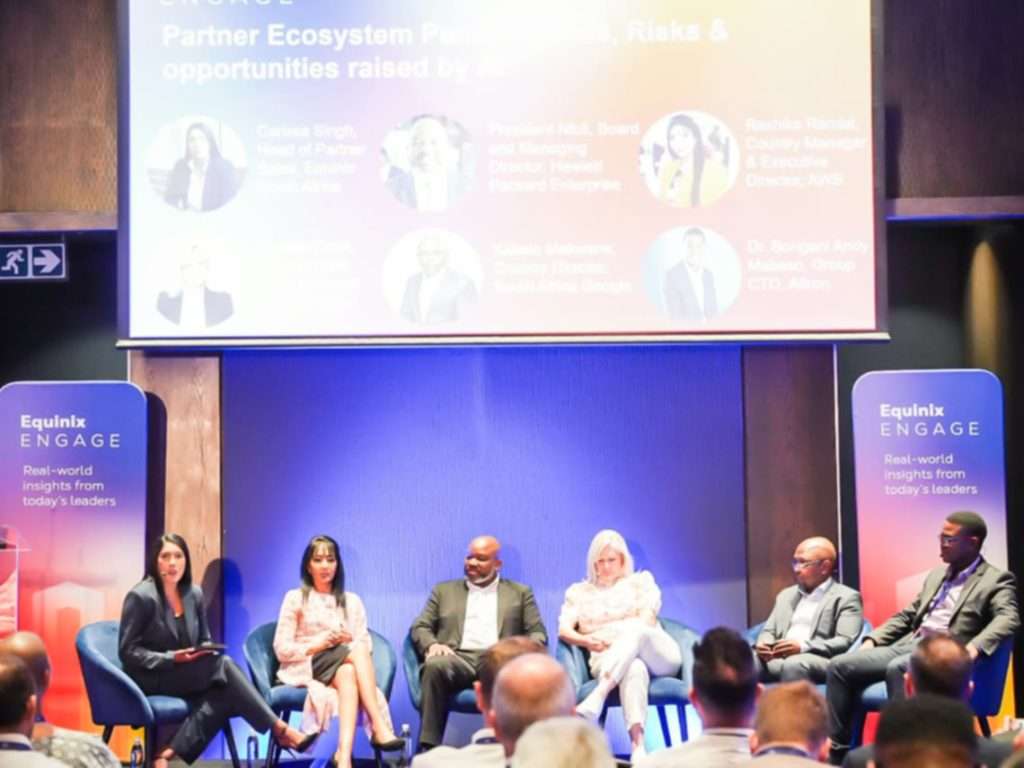
Equinix, CIO South Africa’s trusted partner, hosted the Equinix Engage event at the Marriott Melrose on 7 October to explore the opportunities and challenges around building AI-ready infrastructure.
According to the RAND Corporation, 80 percent of AI projects fail to deliver their intended value. Equinix convened its Engage event to spotlight how today’s IT leaders can prepare their infrastructure to be ready for AI. Headquartered in California, Equinix is a multinational company that provides data centres and global internet connectivity.
In his opening remarks, Sandile Dube, managing director at Equinix, underscored the importance of building AI-ready infrastructure within the South African context. “The AI opportunity is quite significant and it begs the question of what this means locally, particularly in terms of South Africa’s macroeconomic circumstances where unemployment is high and economic growth is lagging,” he said.
Following the opening remarks, attendees heard from Warren Hero, lead architecture and design: segment product process at Sars, who delivered the end-user visionary keynote. Warren took a humanistic approach to AI, highlighting how it is reshaping customer behaviour.
“Customers expect you to change the way you service them every four to six weeks, whereas before these changes were expected quarterly. Businesses that fail to do this risk losing engagement,” he explained. He advised technology leaders to start small with their AI experiments and balance between exploration (innovation) and exploitation (keeping the lights on).
The event featured a strong line-up of speakers including Celenkosini Lukhele, senior manager of digital data transformation at De Beers Group, Dr Ebrahim Patel, head of future markets and sustainability at RMB, Jenny Mohanlall, senior IT director at DHL, and Jochem Melis, CIO of markets at Absa. Each shared strategies and experiences of using AI to drive business success across sectors.
Bridging data vulnerabilities
Jenny reaffirmed the value of starting small with AI initiatives, while Dr Ebrahim spoke about the potential of ethical AI as a competitive advantage. “The ethical nature of your AI strategy and implementation can become a market differentiator, as consumers continue to value ethical brands,” he said.
Jochem emphasised the critical role of cybersecurity in the AI era. “AI brings a lot of opportunity, but there’s also the risk aspect. While we could use AI to help bridge our data vulnerabilities, if a threat actor were to get that information, they could do a lot more damage,” he said.
Celenkosini highlighted barriers to AI implementation, pointing to a lack of vision from senior management and a lack of prioritisation once a decision to adopt AI has been made. He added that resistance to change from employees remains a challenge, recommending that organisations lead with a business problem or opportunity rather than a technology solution.
A representative from Nvidia also addressed attendees, sharing insights into current innovations at the company and how South African enterprises can leverage them.
Throughout the day, the word “ecosystem” resonated as IT leaders acknowledged that building AI-ready infrastructure requires collaboration across the technology landscape. The final panel of the day brought together key players from across the IT ecosystem, including Dr Bongani Andy Mabaso, group CTO at Altron, Juanita Clark, CEO and founder of Digital Council Africa, President Ntuli, managing director of Hewlett Packard Enterprise, Kabelo Makwane, country director of Google South Africa and Rashika Ramlal, country manager and executive director of AWS South Africa.
“We need co-located environments like an Equinix. We need hyperscalers, system scalers and start-ups to innovate on top of your stack. As Altron, we stand at the balcony and advise our customers on what the best configuration of the ecosystem is,” said Dr Bongani.
Rashika and Juanita closed the discussion by noting that AI represents an opportunity rather than a threat for Africa. They said the continent is well positioned to become a global skills hub and emphasised the importance of connectivity across all South African communities to close the digital divide and build an AI-ready nation.