
At the CIO Smarter IT Summit, industry leaders from banking, insurance and transport shared their AI experiences, discussing the opportunities, challenges and defining the line between automation and true AI innovation.

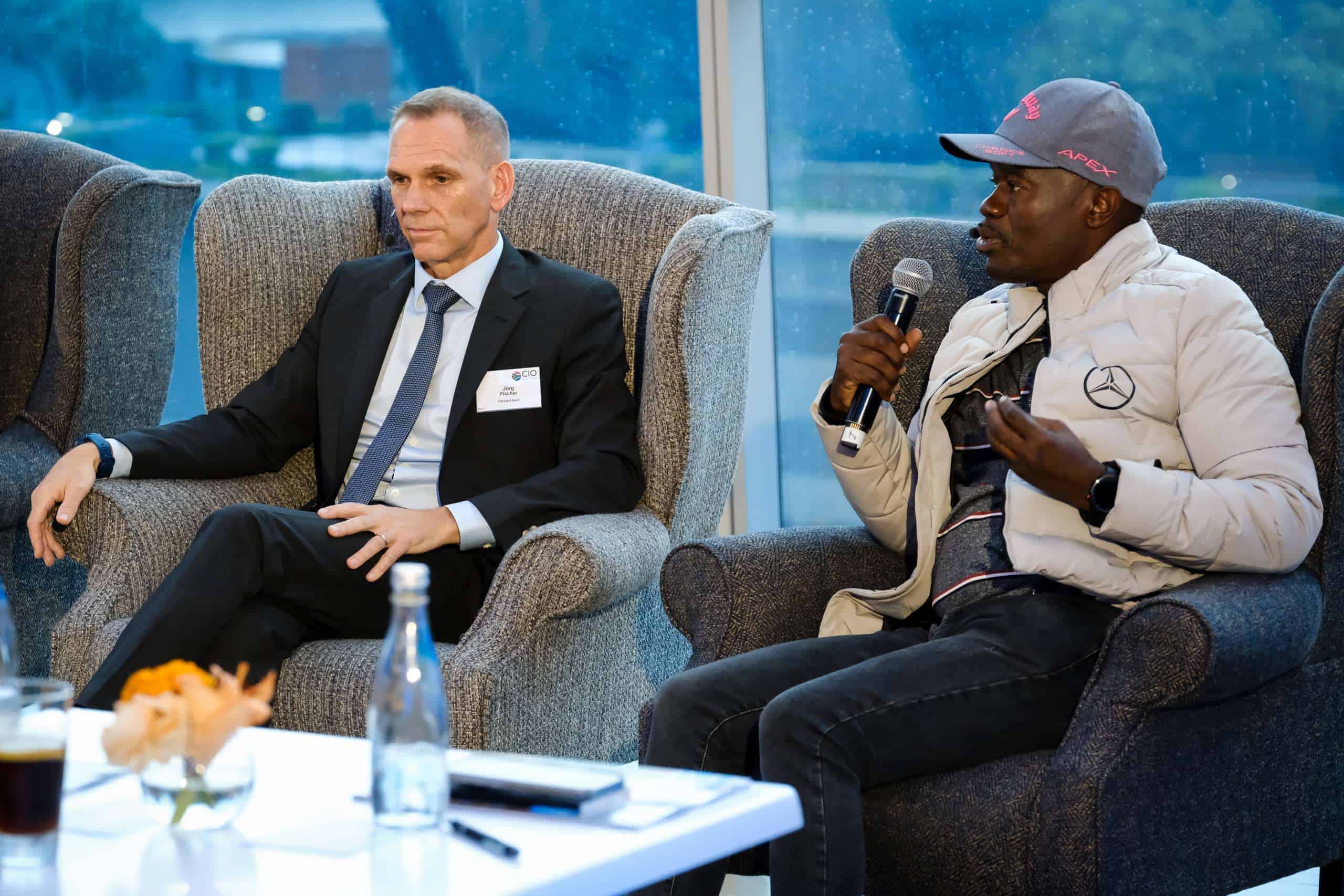
This year’s CIO Smarter IT Summit panel discussion featured 2023 CIO of the Year and Standard Bank Group CIO Jörg Fischer, Telesure Investment Holdings CIO Justin Freeman, and 2024 Public Sector CIO of the Year and Transnet group CIO Pandelani Munyai. Nedbank portfolio executive Mmule Sapula moderated the discussion, exploring the hits, misses and hidden gems of AI, from the private sector to the public sector.
“If we talk about technology adoption, whether it be tools such as Co-pilot, we have adopted a strategy not to risk it, which helps our engineers become more productive. It also depends on your skills base in your technology shop,” said Jörg.
Moving from the technology shop and into the rest of the best, Jörg revealed that in his environment some tension exists. “There is a bit of frustration with business units – it’s ultimately not a tech issue, but understanding the business problems you want to solve,” he noted. “Assessing the proofs of concept (POCs) I currently have in place, I still feel that there is still a lot of runway to go. Much of it has its ideation, do it and fail fast, rather going one step forward than three steps back. Otherwise, I see huge opportunities on the horizon.”

He highlighted that the definition for AI must be made clear, saying that there is some confusion between Gen AI and automation. For example, Gen AI requires the use of graphics processing units (GPUs), otherwise it’s just automation. Users need to consider if their data is in the cloud with the hyperscalers. In that case, it's just automation and not Gen AI – in order for it to be Gen AI it will require massive computing power to give it that definition.”
“On risk and regulation, there is admittedly some catching up to do, to ensure that we’re not crossing the line, and tread carefully,” Justin said. He added that people needed to ensure that their infrastructure is in place for structured data, and these models need to be fed so that they can produce that quality data.
Pandelani highlighted Transnet’s ports as a good example of using AI. He also outlined how Transnet has managed to intelligently capture vessel information for imports and exports using AI. “We’re able to access all types of information, from the vessel’s movements, the captain’s information when it docks, and all the way to the goods on board and SARS information thereof,” Pandelani explained.

“We have IoT installed in tugboats. As a case study, we’ve seen it being difficult for maritime engineers to capture information. We also have AI and IoT devices to help with predictive analysis, to see when vessels are due for service, depending on their age,” he added.
Notwithstanding the simulations Transnet conducts using AI, the rail company can assess when and where cranes need maintenance. Predictive analytics is another area the company is excited to explore more.
Pandelani is on a mission to use AI to empower people and believes that those tools now help their border community. “It’s made life easier for people to generate income statements at ports. Sort information at a central database – if you don’t take this approach, AI will just pull information from all over the place,” he said.

Mmule then threw an important question in the ring: “Is AI just hype or is it real?
“It’s real,” said Pandelani. “We just lack the infrastructure for it to thrive. In terms of platforms, we are there, just look at the data centres. Before you implement AI, you need to be in control of your information and have staff that’s trained on how to manage data. In addition, implementing AI for specific purposes will give you the information you need.”
For Justin, AI is very real too, but only if you have the right use case will you have the right output.
“It’s totally real, and if you don’t adapt, you will get left behind,” Jörg noted. “Business needs to know how to use it, bearing in mind cost and not overshooting in terms of the ROI on AI.”
Pandelani wrapped the conversation up by mentioning that in many cases, budgets are laid out, but as you go deeper into the implementation, those costs skyrocket.