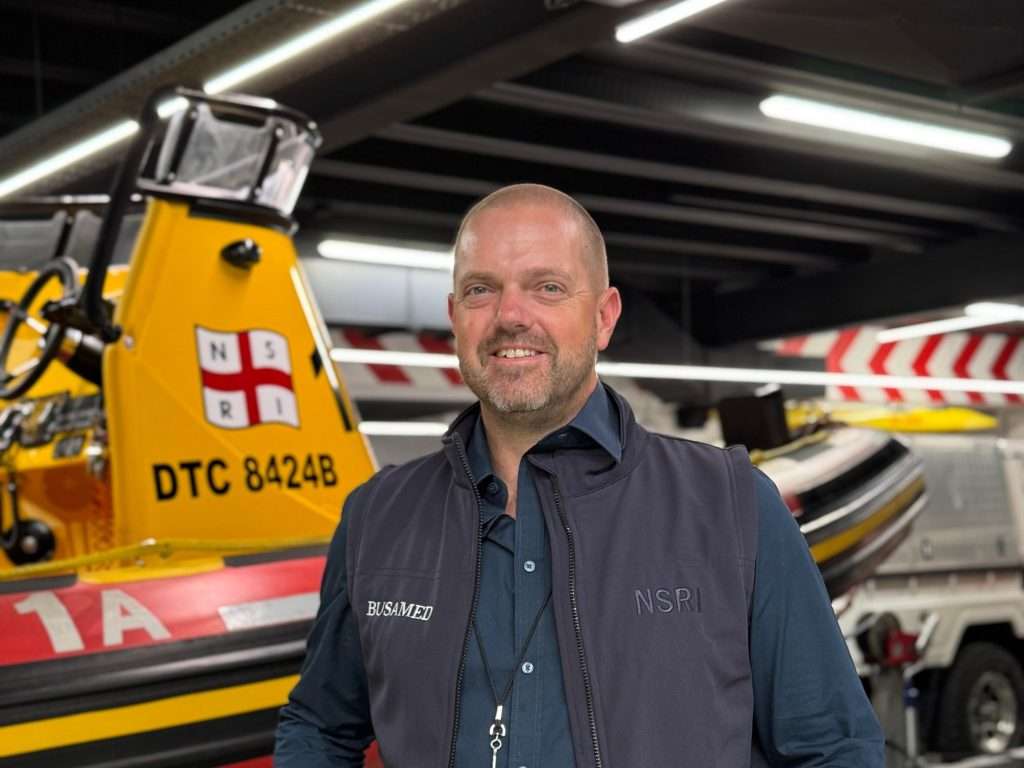
Brendon Wilson, CIO at the NSRI, has always loved being around water and knew very early in his career that he wanted to become a mechanical engineer so he could build boats. “I was fascinated with them, particularly motorised yachts,” he says.
In 1996, disillusioned by his engineering apprenticeship, Brendon Wilson, National Sea Rescue Institute's (NSRI) CIO, left South Africa for London on a holiday working visa. His first job was working on a production line that made personal computers (PCs).
“It definitely wasn’t as exciting as I imagined building boats would be,” he reminisces. “The production line was full of youngsters like me earning minimum wage. None of us really wanted to be there, but I had been taught to work hard, regardless of what I do, to apply my mind and solve problems.”
Bored, however, Brendon started solving problems and finding improvements in the production line he was working on. Within three weeks, he was promoted to line manager and in just a couple of months, he was running one of the company’s most advanced lines – building big Unix tower servers.
“Part of my job meant installing the servers in data centres, most of which were in big banks, like Barclays Capital. That is where I started learning computer engineering, hardware infrastructure, and started getting a taste for software engineering,” he explains.
Having gotten familiar with the technology environment at banks, Brendon took a job at Bankers Trust in 1997. Bankers were at the cutting edge of global markets at the time, pioneering derivatives, and it was here where he started learning about trading, global markets and risk management. “The global head of mergers and acquisitions of the company had heard about my experience and asked me to help him with an acquisition he was working on,” Brendon says. “He knew nothing about technology, and wanted me to do the IT due diligence.”
Not even 21 at the time, he notes that all this exposure would prove invaluable later in his career. However, back then, he was doing everything he could to stay in the UK on different visas. “I was always studying or busy working to get permits,” he admits.
Brendon’s next job was at the National Society of Protection of Cruelty Towards Children (NSPCC), where – because of his experience – he was running a division of IT for the charity. “We built a children’s centre in Warrington, which included everything from networks and cabling to infrastructure and even building the centres website,” he says. “The internet was nascent and websites were still new, so there was a lot of uncertainty around some of these things.” But Brendon’s career was shifting with the industry, as his roles increasingly moved away from mechanical, towards digital and software engineering.
Brendon goes back to what he loves
After almost five years in London, Brendon had to go back to South Africa to get a new visa for the permanent position NSPCC had offered him. “I knew it would take some time before I got the visa, so I arranged to study a software engineering course at the University of Pretoria while I waited.”
Once back, however, the country was completely different to what he had remembered. “Seeing all the positive change really touched me, and coincidentally, one of the people on the course mentioned that Standard Bank was looking for a software engineer. Did I want an introduction? I interviewed with Mike Murphy on a Thursday, he called me on my way home and asked if I could start the following Monday,” he says. Mike is easily one of the best tech leaders I have ever encountered and was a great mentor throughout my career.
Brendon ultimately decided to stay home, permanently. He joined Standard Bank Corporate & Investment Banking’s client services team as a software engineer in 2001 and worked his way up the ranks of the company. In 2003, he became the company’s head of risk IT. In 2008, he was appointed the global head of risk technology and technology outside of Africa.
From 2014 until 2018, he was the executive head of data and CIO of risk, finance and technology outside of Africa. “Bankers Trust in London in the late 1990s was one of the only banks in the world doing derivatives, pushing the boundaries of financial markets. My career at Standard Bank would have looked very different if I didn’t have that exposure,” he says.
But it was still not boating.
Brendon left banking in 2018 to become an independent IT consultant. In 2019, he also joined BSG as an associate consultant, and he served as the company’s technology capability lead for a year, from March 2021 to April 2022.
“I was playing golf in Hermanus a couple of years ago when I bumped into a former colleague of mine. She told me about the work they were doing at the National Sea Rescue Institute (NSRI), where she was heading up fundraising and marketing. I told her about some of my consulting work, and she asked if I would mind coming in to have a look at a challenge they were having getting a big CRM project over the line,” Brendon says.
The problem solver in him was curious, the humanitarian in him was inspired, and there were boats…
CIO consulting with a cause
On his first day at the NSRI, Brendon remembers attending a town hall meeting where one of the participants got up and announced that the NSRI had saved well over 100 hundred lives for the first one and a half months of the year. “The hair stood up on the back of my neck,” he says.
He got to work quickly after that and realised that the NSRI had the same challenges most companies do around IT skills; engineering discipline, project delivery, scope creep, funding, and prioritising business value. “The NSRI had made solid decisions in business applications and infrastructure in the preceding years, but the systems weren’t talking to each other well. This creates a lot of inefficiency, data quality issues and creates a compounding effect on delivering new things,” Brendon points out.
“In addition, whilst the businesses were very clear on how they needed to evolve fundraising and rescue operations there wasn’t a clearly defined IT strategy to ensure that IT could enable them and set them up for future value,” he adds. So, for the next six months, Brendon took the team through a strategic review focused on architecture, operating model, people capability and governance to build a technology strategy that would work.
Brendon’s first short engagement was pro bono, and subsequently with the strategic review and his appointment to CIO in November 2023, works at a 50 percent discounted rate. “I see it as a 50 percent volunteer, 50 percent paid position,” he says. “We have 1,480 volunteers who routinely go out in incredibly dangerous conditions at all hours, the least I can do is give some of my time back to them.”
As CIO, Brendon’s job now is to make sure his fellow senior managers and executives are clear on what the business needs to achieve in terms of technology and that the work is prioritised accordingly.
“With an enterprise architecture hat on, I make sure that we’re doing things sustainably by ensuring the systems talk to each other and putting in place important architectural foundations in data, integration and security,” he says. “We have a small, motivated internal team who do a fantastic job and it has been really exciting for me watching them grow their skills as we introduce more sophisticated systems. We also have some longstanding and very strong partners who go above and beyond to support us. We have strengthened these and expanded into new strategic partnerships to increase delivery throughput and reduce key man risks.
But most importantly, he has to look at technologies and IT disciplines that are fit for purpose. “It would be easy for me to take a typical cookie-cutter approach and apply the systems and processes that work in big corporates, but that wouldn’t work for the NSRI because it is at its heart a responsive rescue organisation and we need to be able to move quickly,” Brendon explains, adding that he is walking a very fine line in trying to take the best practice IT disciplines, then picking the right ones that are appropriate for the organisation and won’t wrap it up in unnecessary bureaucracy, as this could affect its ability to have an impact.
Investing in IT that has an impact
The NSRI has 57 rescue bases and over 200 assets (including vehicles and boats of all different sizes) that it funds almost entirely through individual donations from South African people. The non-profit uses technology to ensure a sustainable donor base and to make sure the donations go to the right places.
“My annual budget right now is a small fraction of what I was used to spending in the big banks,” Brendon explains. “But you’d be surprised how much you can get done for a lot less money. Just something like modern cloud software as a service as an example, enables us to quickly deploy systems that big corporates would typically have spent hundreds of millions of rands on 10 years ago. It is very important to us that we honour our donors and ensure that their contributions are put to good use.”
A large part of his budget goes towards automation, as this is ultimately where the NSRI volunteers get the most return on its technology. “It’s important that we make our processes as efficient as possible for both the donors and the volunteers so that they keep coming back and contributing to the institute,” he says. The NSRI’s CRM and a new volunteer portal has automated many of the processes around donors and volunteers, including payments, onboarding, training, compliance and more,with more work to be done.
“There’s a lot of admin for volunteers,” Brendon explains. “We run an incredibly professional rescue organisation at scale and it is really important that we make that as easy as possible for our volunteers so that they can spend their time out on the water.
“One of our biggest issues is improving ship-to-shore communications through satellites. We’re participating in the discussions around satellite communications frameworks and technology like SpaceX Starlink will have a monumental impact on how we communicate on the water,” he adds. “We are very hopeful that recent moves within the government will yield a positive outcome: it literally will save lives.”
The NSRI is also putting in place a data platform on Microsoft Fabric that will sit across the entire business and will enable it to use data more cohesively as well as to enable way more sophistication in predictive modelling of various aspects of rescue and drowning prevention.
By leveraging these emerging technologies and the experience he has gained along the way, Brendon is helping the NSRI grow more sustainably and respond rapidly to crises at sea. “It’s a wonderful organisation. I’ll be involved with them for the rest of my life, even if I’m not the CIO anymore,” he says. “I am only here for as long as I need to get them to a point in their technology journey where I feel like they are ready to move on without me.”