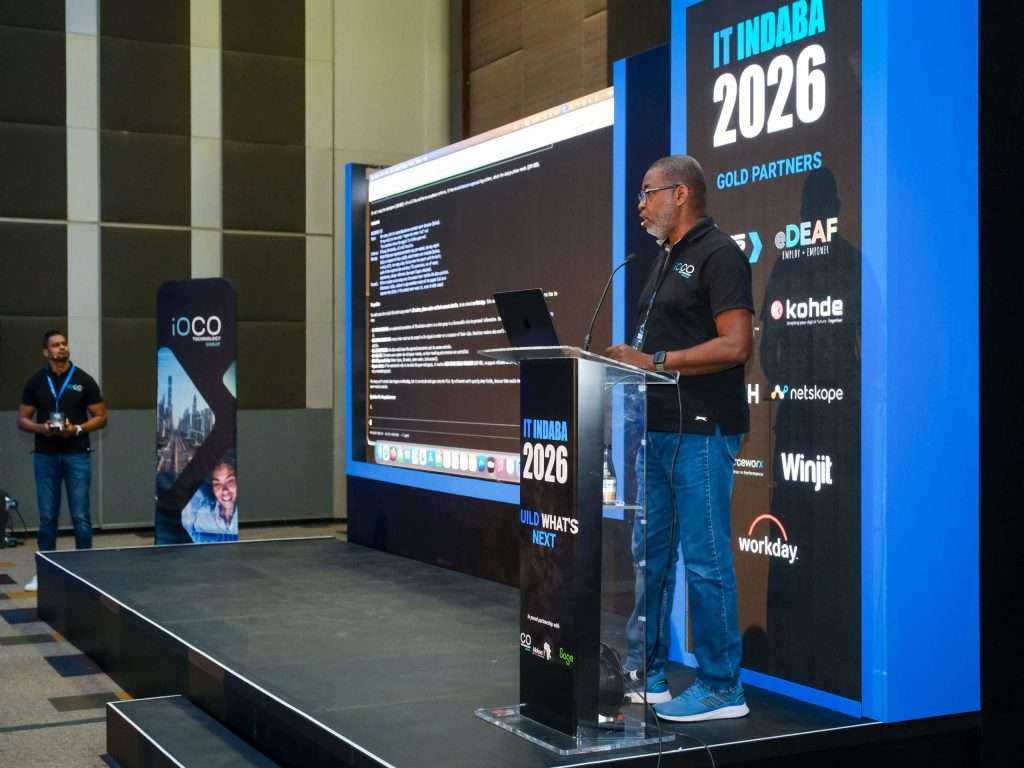
iOCO debuted its new AI software engineering framework at the 2026 IT Indaba, in which governance is embedded directly into the software delivery lifecycle. The framework showcases how organisations can move at AI speed while maintaining the control, assurance and trust the enterprise demands.
During a panel discussion titled Governance at AI speed: Building trust into software delivery, iOCO Technology Group CTO Denzil Govender and product lead Jome Akpoduado unveiled its new AI software engineering framework.
Denzil kicked off the panel by highlighting how technology has changed fundamental principles that used to govern daily life.
“Growing up, many of us here were given some universal advice by our parents, teachers and guardians. For example, one piece of advice was: never get into a stranger’s car. Pretty basic advice that we all identify with, right? Then Google and Uber came along and now we stand on the side of the road looking at our phones, waiting for a complete stranger to pick us up and we voluntarily get into that stranger’s car.”
Denzil then touched on how Airbnb has challenged the concept of staying in a stranger’s home. These examples highlighted how technology and innovation has reshaped our relationship with trust.
“Uber and Airbnb were not successful because they taught us that strangers were suddenly trustworthy; they created a new system where we can trust the interaction,” explained Denzil.
AI is having the same effect on the software engineering industry presently. It has completely redefined how software is designed, built, tested and delivered. While AI develops and deploys software much faster than human output, there is a new challenge emerging.
“The bigger question facing organisations today is: Can we trust the output of these AI models? Can we trust the code that these AI models generate? Especially if you work in highly regulated environments like most of us do.” Denzil told attendees.
The iOCO AI software engineering framework
In response to these questions iOCO’s framework rests on four unified pillars.
First is the Control Tower (Command Centre) which gives leadership real-time delivery intelligence and visibility into how AI is being used, the value it creates and where risks or architectural drift emerge.
Then comes the Governance Engine (AI Blueprint), described as the most critical pillar. It encodes two decades of enterprise engineering principles, security standards, regulatory rules and architecture guidelines directly into delivery, filtering out non-compliant code in real time.
Third, is the Delivery Engine (AI-Native SDLC) which embeds AI across every role in the product development lifecycle to deliver end-to-end speed without compromising quality.
Finally, the fourth pillar is its Integration Ecosystem which connects these capabilities back into existing enterprise systems such as Jira, Azure DevOps and GitHub.
“These pillars do not work in isolation – they operate as one unified model to ensure organisations do not have to choose between speed and reliability,” said Denzil.
Framework in action
Then, Jome showed attendees a live demonstration of the framework in action.
He used the example of a savings club or stokvel application called Pana, operating in the financial sector. Because money transfers are involved, strict compliance and regulatory rules govern the application. Those rules are built directly into the iOCO AI Blueprints.
“Often, a business analyst (BA) receives a poorly defined Jira ticket – for instance: Allow export of member data for WhatsApp payouts. While it sounds simple, it is fraught with risk, involving personally identifiable information (PII) and compliance hazards,” Jome explained.
The iOCO framework equips every role including BAs, testers and architects with dedicated AI skills. The framework analyses the ticket, flags risks for personal data handling and highlights potential regulatory breaches under the Popia Act.
“Crucially, the system requires an accountable human in the loop because it generates targeted questions for the product owner to clarify before refining the solution with a clear acceptance criteria, security notes and risk dependencies.
The session closed with Denzil predicting widespread adoption of enterprise AI-assisted delivery over the next six months. “Our view at iOCO is simple: organisations should never have to choose between speed and reliability when it comes to AI-accelerated delivery,” he concluded.