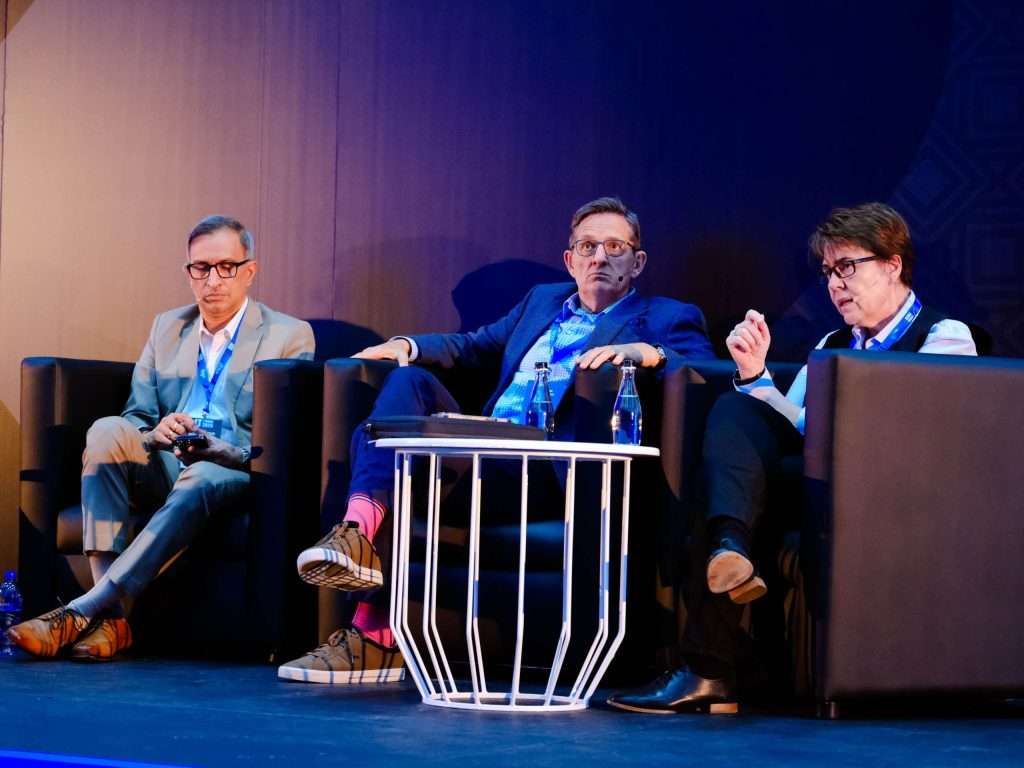
What can South African enterprises learn from CIOs who have navigated IT landscapes across the globe, especially when it comes to shared services? This was a key question posed during a panel discussion at the recent 2025 IT Indaba.
Willie Stegmann, an IT executive with extensive international experience, kicked off the discussion by highlighting that in a multinational enterprise context, shared services are critical, but this doesn’t mean every market has to reinvent the wheel. For Willie, it’s key that the market only uses shared services if it makes sense.
“In the age of AI, we’re all under pressure and there’s no time to wait, but with shared services you can build foundational elements to repeatedly leverage across markets,” said Willie.
Debbie Vermaak, who has held global IT roles for over 20 years and is now CIO at ABF Sugar, echoed this sentiment. Her experience has shown her that CIOs must always consider the local conditions and capabilities, along with what the business’s operating model looks like.
“CIOs must understand the business really well,” said Debbie. “I’ve been in IT for decades, but when I joined ABF Sugar, I had to understand what sugar is all about. I had to go out to operations, see what a mill looks like and learn about sugar byproducts. I discovered that what works in Malawi might not work here. Even if you operate from a central model, don’t run it from the centre; build trust with executives in operations and this will influence the best outcomes.”
“Talk to people in the trenches to see what makes sense,” she added. “Ask yourself: is my centre-based solution fit for purpose?”
From cost-cutting to super-charged productivity
Shared services are known for cost-saving, but they are evolving to deliver more than that, especially with productivity. Panellist Ravi Bhat, Microsoft chief solutions and AI transformation officer, expanded on this by saying that shared services have shifted from labour to technology arbitrage.
“Every role in shared services is changing at speed due to customer demand and AI infiltration – we can’t sit back. Productivity is going through the roof. When people are happier to do their jobs, they can scale much faster through shared infrastructure,” he noted. Ravi added that productivity is now redefined, with technology at the centre of this transformation.
In light of this, Willie pointed out that the four-day workweek has seen much debate in the US, but he doesn’t see it gaining traction in South Africa. For him, this technology-driven productivity boost can seem unequal, as the employer benefits but not necessarily the employee. “That chapter of the book hasn’t been written yet,” he added.
The discussion was then opened to the floor, where an attendee noted that in his South African public-sector organisation, people are “using AI like copy-paste zombies”, as opposed to reaping this technology’s positive benefits. He lamented that when computer literacy is low, AI is hard to implement – a significant challenge in the local context.
In response, Ravi said that basic IT skilling and education is of course critical, but underpinning that is always the question, ‘What will AI do for me?’ The answer depends on the individual’s role and its defined KPIs. “We understand how AI can benefit people, there are basic productivity pieces everyone can do, that move from role to function, department to industry. Organisations can build AI agents to help elevate productivity at each step,” he concluded.