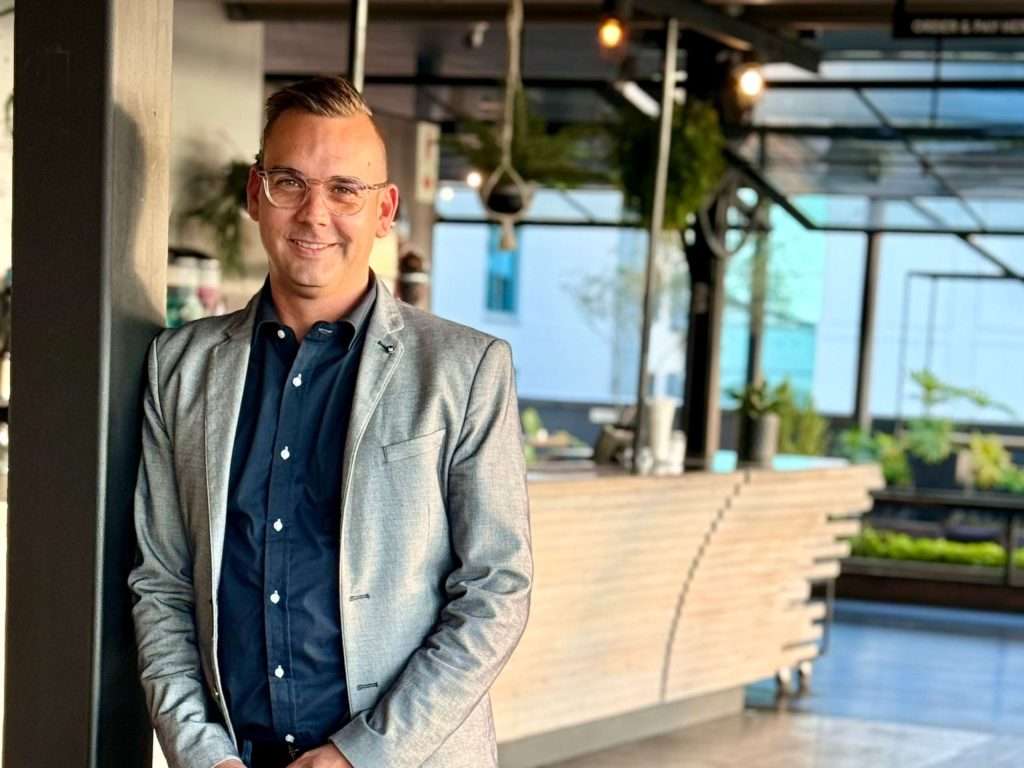
Two Mountains Group CIO Sahann van der Vyver believes effective IT starts with simplicity, alignment and strong communication. His focus is on enabling the business, not adding complexity.
Outside the office, Sahann van der Vyver lives a life that might surprise many of his colleagues. He is a pastor and actively leads a church. “My weekends are around church, not church around my weekends,” he says. His faith informs his leadership style as CIO at Two Mountains Group, where he has a particular emphasis on people, simplicity and accountability.
Sahann’s first meaningful exposure to technology came through operations, where systems were practical tools rather than abstract platforms. He was working for Skynet as an on-site clerk at one of their clients, a laboratory with multiple satellite sites that relied on courier services to move blood samples.
Supporting that operation was a small in-house system, a lean development team and a single database administrator. When the database administrator resigned, that disruption created opportunity.
Sahann left Skynet and took on responsibility for managing the satellite laboratories. Each site ran its own PCs, small servers, network equipment and databases that had to connect reliably. “That’s where it all started,” he says. “I had exposure from network, desktop support, server support, database and software development, all in one.”
That early immersion shaped his view of IT. Rather than specialising immediately, he saw the entire chain and how easily it could break down. “Software will run but the network and desktop teams are not aware. Then it’s either duplicate work or delays because someone wasn’t informed,” he explains. The lesson stayed with him.
Today, as CIO of Two Mountains Group, his focus is on preventing those fractures. He joined the organisation initially to lead premium collection and client retention strategy. Data, projects and ultimately IT followed.
Technology as an enabler
What Sahann values most in the CIO role is oversight rather than authority. “I enjoy having oversight of all the people in the IT umbrella and making sure that they all communicate with each other,” he says. For him, coordination is what determines whether IT becomes a bottleneck or an accelerator. “If everybody just knows about a particular project from the beginning, you can move fast instead of slow.”
That emphasis on visibility shapes how he approaches delivery. He is candid about IT’s reputation for missing deadlines. “IT as a whole has a bad reputation for not delivering on time,” he acknowledges. His response is to involve data, infrastructure, software and networks early, instead of treating technology as an afterthought. “We are not road blockers. IT must be seen as an enabling business.”
Fit for purpose is also central to his philosophy. Scale alone, he argues, does not justify complexity. “It’s important to implement technology that is aligned to your organisation’s goals rather than technology for the sake of technology. I still want the best, but the best for the size and the purpose,” he explains.
That thinking informs his architectural decisions. Two Mountains Group is moving towards a fully cloud-based environment with a deliberately lean internal team. The focus is on using existing structures and partners so that IT becomes an orchestration function rather than one centred on ownership.
Starting with a relatively clean slate has enabled aggressive simplification, particularly in data. “Our approach to data has been unique in that we have intentionally chosen not to build unnecessary complexity. I can answer most questions about the business with only a few simple databases,” he says.
In his view, complexity often accumulates because organisations struggle to let go. “We went through a phase where data was like gold and we just accumulated everything. Now many companies are sitting with so much data that they don’t know how to use it, and we have been intentional about avoiding that.”
Leading people, not systems
Sahann’s leadership style has evolved through experience. Early in his career, he felt the need to prove himself by doing everything. “You want to know it all, you want to do it all,” he says. Over time, that approach led to burnout. The shift came when he learnt to trust specialists and recognise the value of subject matter experts.
A key focus for him is understanding team members as individuals. One practical tool he uses is exploring how people respond to recognition. “I get my team to do the love language test so I can understand what types of rewards each team member values. When you understand your people, you get the best out of them,” he adds.
That relational approach extends to how he defines the CIO role. He believes it is often misunderstood. “People think the CIO focuses on operational technology, but in reality the role is deeply relational. The key is to have the right relationships to make the journey easier.”
When it comes to measuring IT effectiveness, Sahann places significant weight on sentiment. “I gauge the temperature of the clients,” he says, referring to internal stakeholders. Traditional metrics remain relevant, but they do not tell the full story. “If they’re happy, I know IT is doing its job.”
Away from work, he spends time outdoors, mountain biking, tackling DIY projects and reconnecting with nature. Reading is another anchor. He is currently reading The Comfort Crisis by Michael Easter, which he says reinforced the idea that comfort limits imagination.
One of his strongest personal passions is working with men and fathers. “One of our fundamental problems as a society is that fathers are not present,” he says. Through father and son initiatives, school engagements and outdoor programmes, he focuses on creating spaces for connection.
He is also involved in charitable work supporting breast cancer awareness and organisations addressing human trafficking and abuse. These commitments, he says, are not separate from leadership but part of how he understands responsibility.