
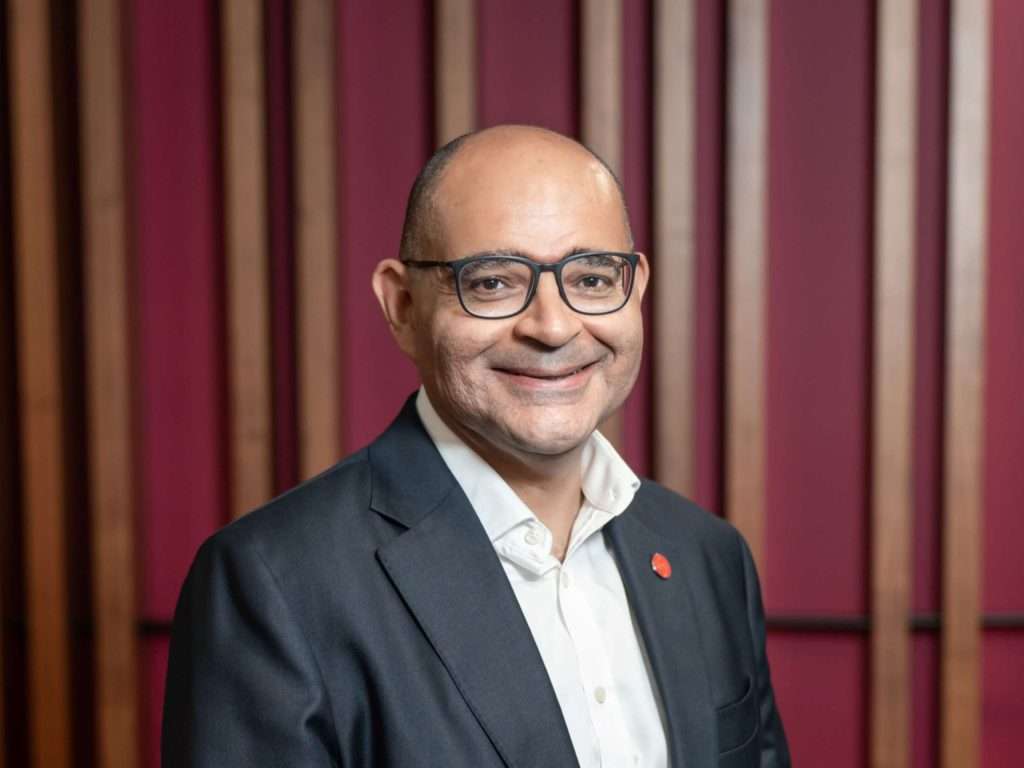
Absa Bank’s group CITO (GCITO) Johnson Idesoh is a firm believer that technology is, at its heart, a people business. He may be the 2025 CIO of the Year, and also winner of the Smart Data and Digital Innovation awards, but the thread that runs through his story is not technology, it is purpose.
The Scottish-Nigerian, who grew up in Lagos, studied avionics, spent two decades moving between continents, completed an MBA while holding down a senior role, and attended Harvard's Advanced Management Programme. He is a Pilates devotee and has a real appreciation for the arts. Johnson is also the kind of executive who will tell you, without a hint of self-consciousness, that he gets “put in his place” by his teenage son.
“A lot of my job is to change what people believe,” he said reflectively. For a man who leads technology for one of the continent’s most significant banking institutions, it is a surprisingly philosophical place to start.
But then, Johnson is not your typical GCITO. His career reads like a study in deliberate reinvention. He began it as an avionics graduate which he described as computer science for aircraft, before joining what was then Andersen Consulting (now Accenture). “That was a phenomenal growth experience for a variety of reasons. I got to work in multiple countries as a young person, which is an invaluable experience, and you get to work in multiple industries,” he elaborated.
From there came AstraZeneca – he joined the Swedish side, Astra, before the merger with Zeneca – and then, after seven years, a move to Aviva in the UK. “I always wanted to work in industries where technology is at the heart of the organisation, where it is a really strategically important asset,” he said. He spent time in each world for roughly seven years apiece, a pattern he has noticed himself. “Seven years at Accenture, seven years at AstraZeneca. There does seem to be something about seven years,” he quipped.
But it was always Africa calling. “Because I grew up in Nigeria, I always said that at some stage of my career I would work on the African continent.” In 2014, he joined Old Mutual in South Africa – not in London, he is quick to point out – first as CTO and then as CIO from 2018. The move to Absa came in 2023 and brought with it a shift from insurance into banking. “Absa is my first big banking brand,” he said. “But there is some logic. I have always gravitated towards sectors where technology really matters.”
Purpose above everything
The thread that runs through Johnson’s story is not technology, it is purpose. He uses the word often and he means it. It was solidified, he added, during the Harvard Advanced Management programme, which he described as a rare learning experience that genuinely shifts a worldview. “What it did was cement my view that you need purpose in everything you do. Yes, we all work for commercial entities. We have to be profitable. But any organisation I work for really needs a strong sense of purpose and it needs to connect to what I feel.”
At Absa, that purpose manifests in ways that go well beyond technology delivery. When he joined the bank, they restarted graduate recruitment into technology. Last year was the first cohort. This year, they almost doubled the intake.
“There is absolutely no reason why the African continent cannot have leading technology skills,' he said. “The cost of technology keeps coming down – cloud, generative AI, it just keeps driving that cost down. We know we live on a continent that needs to drive economic growth. Every graduate we give an opportunity to probably has a family or an extended family for whom this is genuinely life-changing.”
He recalled a recent morning in Johannesburg when he was not officially scheduled to meet the new graduate cohort. “I was in Joburg and I just went. The reason it matters is clear: you are creating jobs, meaningful jobs. You are building skills. You change one life. It changes five more.”
Helping the disabled be more abled
One of the programmes Johnson speaks about with particular pride is Absa's partnership with the Hein Wagner SA Academy, which specialises in the post-grade 12 training of blind and visually impaired persons. Absa sponsored their very first three-year cybersecurity certification programme. The first cohort graduated in 2024 and some of those graduates are now employed at the bank; and one of them presented to the board earlier this year.
“Their skills are as good as you will get anywhere in the world,” he said simply. The programme, he added, reflects something one of his colleagues articulated beautifully: Technology helps the disabled be more abled. “They can contribute to society. They can feel that they are contributing in a job that is needed. They do not feel on the outskirts of society. They feel part of it.”
At any given time, Absa is sponsoring several hundred learnerships – matriculants, career returners, people building skills in architecture, cybersecurity and cloud platforms. “I would like most of them to join Absa, but actually getting them into jobs anywhere is a good thing,” he noted.
The loneliness of leadership
For all the recognition, Johnson is candid about the harder chapters. His career low points, he shared, have a consistent theme, and it is not about projects that failed or technologies that fell short. “My low lights would be when I found myself thinking I see a potential issue here, but I did not deal with it quickly enough. And the reason, when I am honest, tends to be simple: I was questioning my own judgement, or I was trying to fix something for too long,” he explained.
“One of the challenges of leadership is that it is lonely. You can feel that you have to fix everything. But it is actually a very astute leader who realises that asking for help is a good thing.” It is a lesson he now passes on. Early escalation is good, he tells his team and he says it often, he reiterated.
The flip side, he added, is that experience eventually teaches you to trust yourself. “Sometimes people say, Johnson, you seem to decide quickly. But it is because you learn to trust your judgement. It is better to call things.”
In an era where artificial intelligence and digital transformation dominate the corporate agenda, Johnson firmly believes that vulnerability and authenticity are a leader’s greatest assets. He is a staunch advocate for breaking down the traditional, rigid corporate façade.
“I think many leaders fall into this trap of thinking you need to be super human. Don’t show that you also have emotions, don’t show that you’re also a human being, leave your personality almost at the turnstile as you come in,” he explained. “I think it’s really important as a leader that you show you are human and that your colleagues can see.”
For Johnson, leadership is not about having all the answers or remaining stoic; it is about establishing a clear sense of direction while remaining deeply empathetic. He boils his leadership ethos down to a golden rule: “Maybe it's as simple as saying you treat others the way you’d like to be treated yourself. You’re human. You’re consistent and you paint a clear sense of direction.”
Pilates, ballet and a teen who gives one-word answers
Outside the office, Johnson is a man of quietly unexpected enthusiasms. He is married and has a son who is almost 15. “He puts me firmly in my place,” he laughed. “The answer to anything at this stage is fine or good. One word. That is what you get.”
His relaxation comes from Pilates, practised seriously and regularly. “I do it avidly,” he said. “There is the physical side, your core and so on, but for me it is almost meditative. When the world around you is going at pace, it is a way to calm and still the mind.” From time to time, he also meditates. 'Perhaps unusual for someone with an engineering background,' he conceded, “but it works for me.”
He also has a genuine appreciation for the arts – all kinds. “Whether it is the art show in Riebeek Kasteel, a small town in the Western Cape that runs a show once a year, or ballet, you will find me there.” It is a side of him that surprises people, he acknowledged, but it is entirely consistent with someone shaped by multiple cultures and countries. “I have lived in different places and that has been a real benefit to me. I am inherently interested in travel and culture. As a family, we go and explore different parts of the world, and we are lucky to be able to do that.”
A business about people
For all the cloud platforms and AI deployments and industry accolades, Johnson keeps returning to the same point. The future of technology – certainly on this continent – will be decided not by the tools, but by the people who wield them. He is adamant that the two most important skills for anyone entering the workforce today are adaptability and empathy.
“The one thing AI does not yet have is genuine empathy,” he noted. “It may appear to be, when you are chatting to your agent. But the paradox of the world we live in is this: the more technology-enabled you become, the more the human connection matters. In banking, in financial services, in almost every industry, empathy is becoming more important, not less.”
He smiled when someone recently mentioned that, apparently, one gets better responses from your AI tools if you are polite to them. “Maybe there is a little bit of something in that. Connections are important. Relationships are important. As a human being, it is one of the fundamentals. And I think, despite – or perhaps because of – the advanced world we live in, we all need to remember that,” he reflected. “Even though I am a CIO, I would say this: technology is a business about people.”