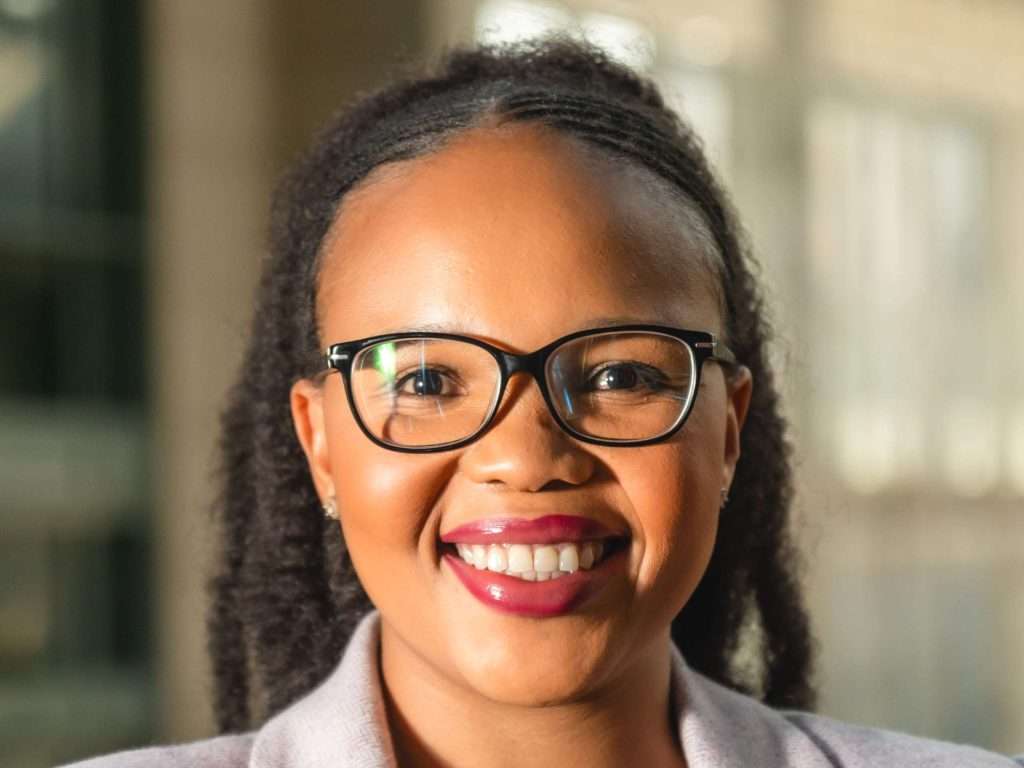
Whether it’s rebuilding banking architecture, uplifting her team and women or raising a family in nature, Absa Personal and Private Banking Specialised Operations Technology CIO Khanyisa Mhlaba is shaping systems, breaking boundaries and unlocking human potential.
When Khanyisa Mhlaba speaks of the concept of integration, she’s not only referring to systems. She is also talking about careers, complexities, communities, and finding synergies between them.
As the CIO of Specialised Operations Technology at Absa Personal and Private Banking, Khanyisa leads a team of 200 people and oversees five of the bank’s specialised operational areas – fraud, customer regulatory onboarding, collections and recovery, personal to bank payments and operations enablement – each supported by a patchwork of technologies ranging from cloud infrastructure to legacy systems, Salesforce, Fico, Avaya and AWS stacks.
It’s a vast and complex environment, but to Khanyisa, it’s also a significant opportunity to improve systems, process and people. “I enjoy figuring things out,” she says. “I’m the kind of person who thrives in a whiteboard session. I like removing blockers. I want to make things better. I just happen to use technology to do that most of the time.”
Her path to this role was neither straight nor easy, representing a massive leap from her childhood in the Eastern Cape. “I didn’t grow up wanting to be in IT,” she explains. “But I remember a day where I saw a black DOS screen at my mom’s workplace. Her boss at the time let me play on it – and something stuck.” That early exposure set her on a path no one in her family fully understood. With traditional careers like teaching and nursing seen as the only viable options, Khanyisa was expected to follow suit but those were not career paths she was passionate about or wanted to explore.
Before she could begin her studies, she needed to convince her family that breaking away from tradition was the right choice. “I started frantically scanning the classifieds, looking for something they wouldn’t understand well enough to talk me out of,” she recalls. That’s when she came across an advertisement for a Cisco computer course; something she didn’t fully understand but knew sounded serious. “It just sounded technical and impressive. My dad wouldn’t know how to argue with that.”
She eventually enrolled in a software development programme at PE Technikon, now known as Nelson Mandela University. Her motivation was clear: “I didn’t know much, but I understood that failing meant going back to nursing or teaching. That was all the motivation I needed. They gave me one year to either pass this computer course or I would have to study teaching or nursing instead. So, I passed,” she shares.
The power of women in tech
Khanyisa has never had a female tech manager throughout her career, and she is determined to change the landscape for others. “I’ve always felt like the odd one out. In school, I was the only student of colour. In tech teams, I was often the only woman. There was no blueprint. You just had to figure things out on your own.”
That’s why she is focused on bringing more women into the field, particularly by hiring women for core technical roles – not just as administrators or support staff, but as engineers, developers, and architects.
Khanyisa also mentors women across various teams and divisions: “If there’s a presentation that could make someone shine, I’ll sit with them until the deck is done. I want women to thrive, not worry about being the only one in the room,” she says.
Her fervent commitment to uplifting women does not negate an appreciation for the role that men have played in her life and career. She acknowledges that men have been a significant source of strength for her. “Men have been some of my biggest advocates. They believed in me before I could believe in myself and opened doors for me. Now it’s about showing other women that they don’t need to change who they are – they just need to excel at what they do and own their space.”
Khanyisa’s career began at Accenture, where she was quickly immersed in supporting a COBOL-based treasury system, despite having trained in .NET. When her internship ended without a permanent job offer, she swiftly pivoted, to TIBCO Software, where she was trained in a completely new technology stack. “We were asked to choose between Business Process Management and Integration. I instinctively chose Integration – and I was the only woman in that stream.”
This choice proved to be formative for her career. “That was when I use what I call the ‘black box’ mindset. I realised it’s not about the language or the tech. It’s about understanding what needs to be done and figuring out how to make disparate things work together to get to the desired output. That’s what makes integration so powerful. It’s thinking in “Lego blocks,” she explains.
Building it right
This mindset became a guiding principle throughout her career, from building Telkom’s mobile network during the early days of 8ta to leading system redesigns at Vodacom. There she conceptualised and rebuilt the managed services provision engine into its revised modular architecture version praised for its agility and elegance. Once again, her Lego block metaphor served her well: “Build it correctly, and you can plug and play endlessly,” she says.
At Absa she currently oversees the replacement of legacy voice systems with AWS Connect – a multi-year project that has required regulatory approvals, enterprise-wide buy-in, and “double planning, then planning again”. Keenly aware of the challenge, she says: “It took more than two years just to get to the start line. And now we’re rolling it out.”
When the stakes are high, often accompanied by with immense stress and challenges, Khanyisa believes that character is just as important as competence. “Projects will go wrong; that’s the nature of technology. But what I’ve learned is this: be the kind of person people want by their side during a crisis. If something breaks at 2am, I’ll be the one picking up the phone,” she says.
Her belief in servant leadership is more than just a description or buzzword; it is a fundamental practice for her. “I used to be an usher at church. Serving is part of who I am. I don’t see it as being beneath anyone. I see it as the power to enable.” This ability to empower her team doesn’t come from motivational speeches but rather from simplifying complex issues, asking the right questions, and maintaining a direct and focused approach. “I’m not here to provide answers. I’m here to help my team uncover them. I don’t want fluff. Don’t show me pretty pictures that mean nothing – give me the real story,” she asserts.
She describes her communication and decision-making style as “crisp,” and she is deeply committed to ensuring that tech projects are delivered on time and within budget. “I’m currently reading How Big Things Get Done by Bent Flyvbjerg and Dan Gardner. I want to understand why tech project are often late to deliver and how we can fix this issue.”
Leading with a beginner’s mindset
A distinctive aspect of Khanyisa’s leadership style is her commitment to humility and what she refers to as the “beginner’s mindset.”
“I’m not afraid to look like the least knowledgeable person in the room. I’ll ask my peers, ‘How did you do this?’ I go to the call centres and say, ‘You’ve been here longer than I have. What should I know?’ People want to be heard. And they usually have the answers,” she explains.
At the same time, Khanyisa is very realistic about navigating challenges and being inclusive, even when managing change. “It’s going to be hard. So we start early. We talk, we listen, and we keep coming back. People aren’t resistant to change; they’re resistant to being excluded from it,” she says.
Away from Absa’s complex architecture, Khanyisa finds clarity in nature. She lives in Mpumalanga close to the Kruger National Park, where she raises chickens, pigs and rabbits, supplying fresh food to nearby villages. “We grew up with food we planted ourselves. Butter wasn’t bought; it was made. We didn’t have money, but we were rich.”
She aims to recreate that richness for her own children – not through malls or screens, but with orchards, waterfalls, visits to the Kruger National Park and long road trips across Africa. “I love my Africa,” she says, recalling her favourite holiday: a cross-continental overlanding trip with her husband from South Africa to Tanzania and Zanzibar. “We pitched tents, cooked under the stars, and met people along the way. It was the best thing ever.”
If money were no object, she would spend her life travelling across Africa to support children – helping with food, homes, and education – backed by farming. “That’s what I’d do. That’s what fills my cup.”