Artificial intelligence is as transformative as electricity was to previous generations, fundamentally reshaping how we live and work.
Few innovations in human history have fundamentally changed the way we live, work and interact like electricity did – and AI is the electricity of our current age.
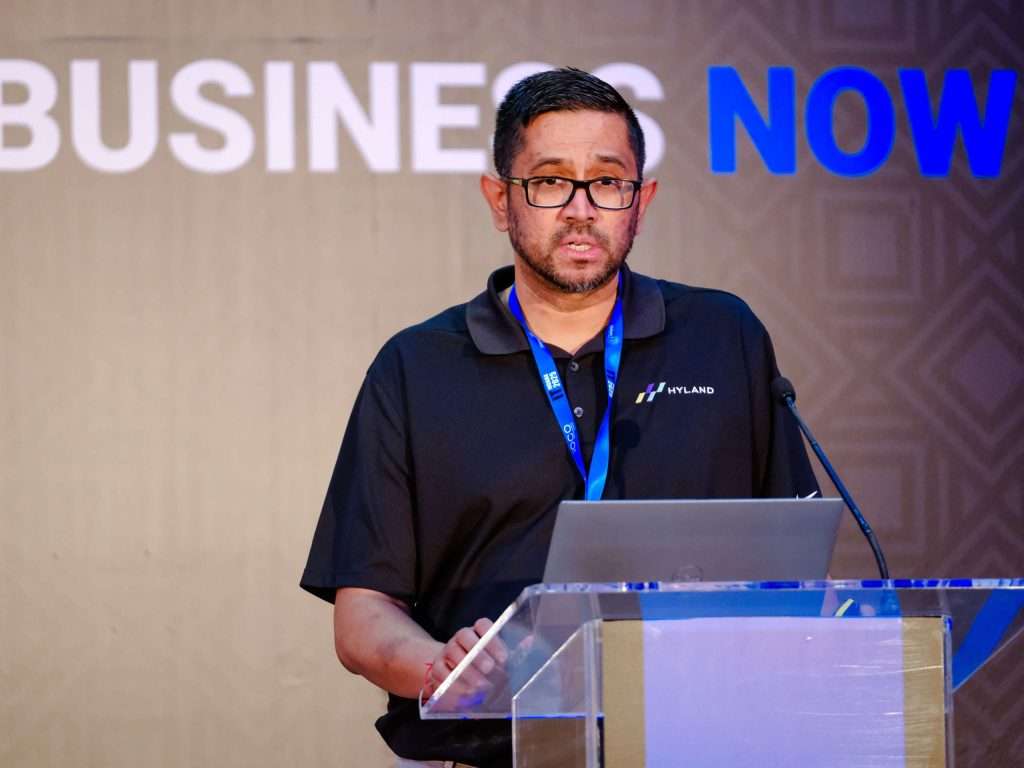
This is according to Derren Naidoo, Sales Manager at Hyland, who told delegates at the recent IT Indaba that electricity was a foundational innovation that enabled infrastructure such as grids, wires and the engines that turned electricity into light, heat and motion.
“That genie could not be put back into that bottle. Once it was out in the world, we made it ubiquitous and it changed the world,” said Derren.
Derren said that AI is poised to have a similar transformative effect. “We are living in an era where we have discovered something just as powerful as electricity, and that's artificial intelligence,” he said.
Delving back into history, Derren reminded the audience that IBM's Deep Blue defeated then world chess champion, Garry Kasparov, in 1997. “Think about where we’ve come from, where we are today, from those types of innovations,” he said.
Modernisation no longer optional
Derren said that “with every advent of generative AI, it's becoming increasingly clear that modernisation is no longer optional. It's key to staying competitive in today’s fast-paced business world”.
Just as modernisation starts the journey, automation and intelligence unlock the value, said Derren. For enterprises, ubiquitous AI enables real-time data-driven decisions, predictive insights, and adaptive operations, he added
“Imagine the kind of informed decisions that we could make. With deep contextual understanding of your business, you can now empower agents to find the data and information they need, make decisions, and execute actions,” said Derren.
Derren did note that there is a failure rate of close to 95 percent of projects globally. However, he doesn’t see that as failure, because “the learnings that we go through in those failures have given us a lot”.
Data is key
A key lesson is that generative AI starts with great data, said Derren. “As an organisation, harnessing the full potential of AI requires you to prioritise data management. You need access to accurate, reliable and well-organised data. The better the data, the better the AI,” he explained.
Most, at around 80 percent, of enterprise data is unstructured, a figure that is growing, said Derren. He pointed to widely cited research indicating that, between 2020 and 2025, global data creation was projected to grow to more than 180 zettabytes – or roughly 180 trillion gigabytes. A single zettabyte is equivalent to about 250 billion DVDs.
“That’s crazy. That’s insane to think about. I mean, we’ve been talking about the growth and explosion of data for many years, but 180 zettabytes, that’s crazy,” said Derren.
The undiscovered treasure chest
The amount of data available is, however, an “undiscovered treasure chest,” added Derren. “The CIO’s mandate, once again, is to unlock it, unify it and let agentic AI turn it into a competitive advantage,” he said.
Yet, this data is fragmented. “If fragmentation is the problem, unification is the answer. Unification is how you will drive focus,” said Derren.
Almost counterintuitively, Derren said that one step to unification is, ironically, embracing fragmentation. “So don’t fight it. Meet your content where it is. Don’t launch yet another migration of content into yet another repository and create a new repository of information. Embrace the hybrid,” he said.
This, Derren said, included embracing multi-cloud deployments.
Once a unified view of data has been created, companies can determine its purpose and how mission-critical it is before taking any other action, enabling them to build end-to-end unified processes, noted Derren.
Self-healing autonomous agents
Following this, companies can deploy autonomous, agentic AI to drive operational efficiency and insight, said Derren.
“With autonomous agents, one of the benefits is they can be self-healing. So, when they fail on a task, they can do the research themselves, understand what failed, why it failed, fix themselves without interaction from us,” he noted.
Moving beyond just digitisation towards enterprise-wide intelligence drives cross-domain orchestration of people, processes and content through unified agent measures and enterprise context engines, said Derren.
“Let’s try to measure success not by IT uptime, but by intelligence velocity. How fast new insights flow from data to action,” he said.
As Derren noted, “the technology era has forced us to spend more time with our devices in the past. AI, I believe, will free us from this and we can spend more time with each other”.