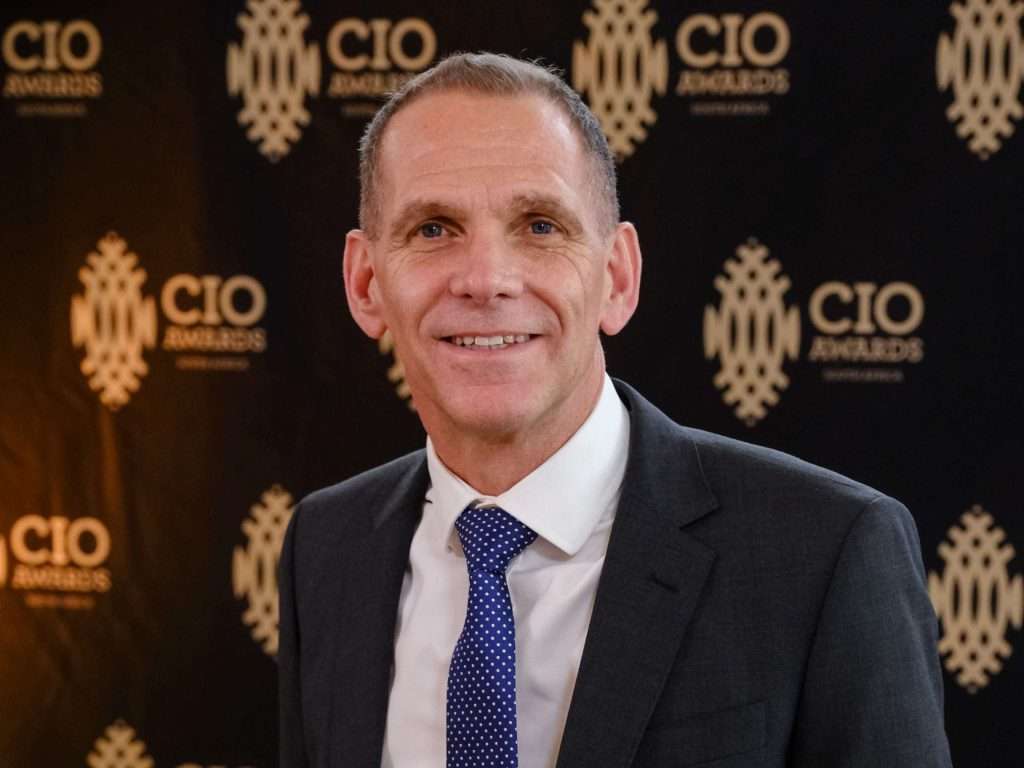
Jörg Fischer, Standard Bank group CIO, took to the main stage for a fireside chat with Microsoft Middle East and Africa president Naim Yazbeck at the Microsoft AI Tour on 29 January 2026 to help guide technology leaders on adopting AI in their organisations.
Standard Bank group CIO Jörg Fischer says AI must be treated as an organisational change, not a technology project, if companies want to become what he calls a frontier firm.
Speaking at the Microsoft AI Tour, Jörg says organisations must rethink how they operate, how employees work and how customers are served. He warns that treating AI as a side project or a set of use cases would limit its impact.
“You have to reshape the organisation and change the whole client and employee experience as well as processes. This is not automation, it is a fundamental shift.”
Jörg traces earlier waves of banking transformation, from branches to ATMs, then internet banking, mobile apps and cloud platforms. According to him, AI represents the next major shift and will sit at the centre of how organisations work, not on top of existing systems.
He says Standard Bank’s leadership has made AI a core priority, with the CEO personally driving the agenda and the appointment of a chief AI officer. “This is an organisational change, it is not something on the side,” he adds.
He also explains that skills and culture are as important as technology. At Standard Bank, AI training is mandatory for all employees, with deeper programmes for specialist roles.
Cybersecurity risks in the era of agentic AI
Additionally, Jörg says trust is non-negotiable in banking and must be built into AI platforms from the start. He warned against treating security as a gatekeeping function that reviews each use case individually.
“You do not want to go to security 50 times for 50 use cases. You want security, risk and compliance built into the platform from day one.”
Data access, permissions, auditability and transparency are critical in an AI environment, where systems can surface large volumes of information quickly. Security teams, risk teams and compliance teams must be part of the journey from the outset. Jörg explains that this approach enables faster deployment of AI across the organisation, while maintaining trust and regulatory compliance.
On the role of AI in South Africa, he adds that technology could help banks serve a highly diverse population, including multiple languages and communities, through more personalised and lower cost services. “AI brings much more personalisation. It also makes services cheaper and puts them in the hands of individuals.”
He sees South Africa as having a great opportunity to become a centre of excellence for AI development, given its skills base and growing digital infrastructure, and that AI could help bridge economic divides between developed and developing markets.
Reflecting on leadership lessons, Jörg said the first priority is recognising that AI is not a technology project, but an organisation-wide transformation linked to strategy and purpose.
The second is not underestimating cultural change and skills development. The third is building the right foundations from the start, particularly around security and governance. The fourth is choosing strong partners.
“This is a journey that even we at Standard Bank are still on. The key is to build it correctly from day one and then deliver at scale.”