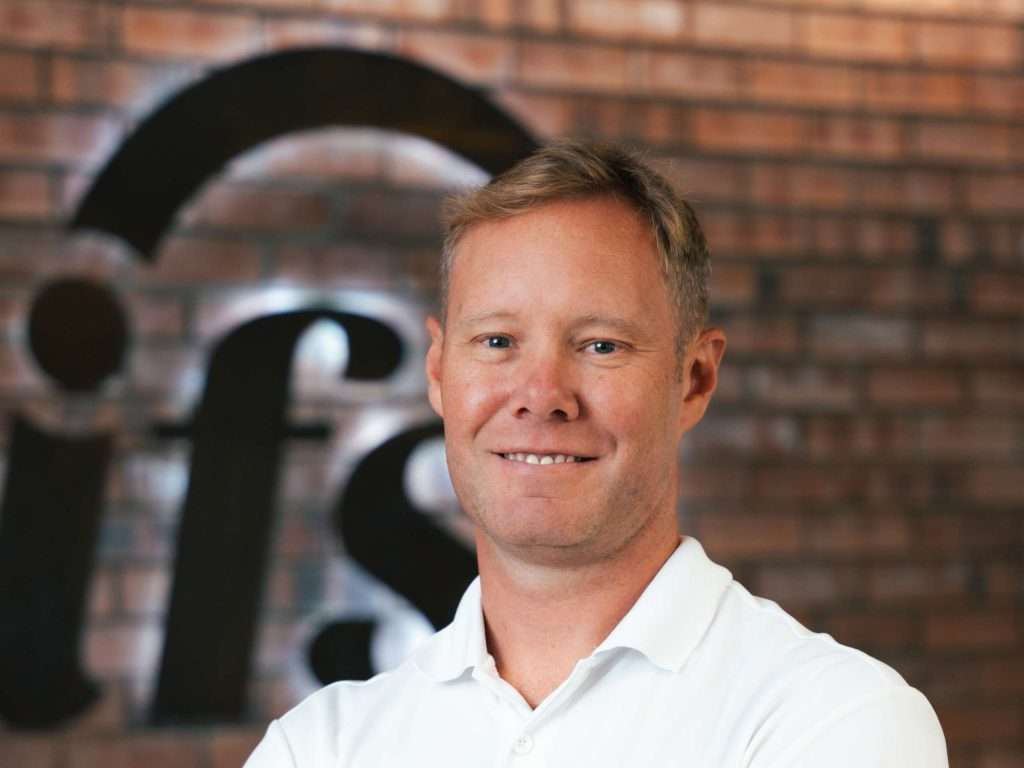
IFS head of group IT Andrew Britz is connecting Africa’s most remote operations the way he deep-sea fishes in the Indian Ocean – with whatever he has at his disposal.
While many executives begin their day reaching for their smartphones, Andrew Britz starts his by paddling a kayak into the Indian Ocean off Durban's coast to catch fish. “It’s a way of doing deep-sea fishing without owning a boat,” he says with characteristic pragmatism. “You’re more active than on a ski boat, and it doesn’t take hours to launch.”
He applies a similar approach to his career, making the most of what is available to him.
After studying IT and programming, Andrew worked in the UK for the National Health Service (NHS), where he progressed from programmer to team leader. “I was quite involved in the patient information management system and the development of that system,” Andrew explains. “Towards the end, I was managing the team and that was really my first foray into IT management.”
Andrew returned to his home country when his wife – also a South African – was pregnant with their first child. Back in Durban, he joined Keyrus a progressive BI consulting firm in the financial services space, after which Andrew then moved onto Momentum Health, where he ran application development for their medical aid platform. “We had about 50 developers full-time in that space, with a very rigid development structure and a massive amount of governance and controls around that,” he recalls.
While it was a significant task to manage the project, it gave Andrew the foundational and procedural expertise he needed later, when he joined International Facilities Services (IFS) to lead the IT with a mandate for progressing IFS into the digital age. Here, he is tasked with digital transformation across some of Africa's most remote industrial sites, where connectivity is scarce and infrastructure unreliable. “We operate in places like Mozambique, Zambia and the DRC,” he explains. “Our core function is really facilities management on remote mining sites where there are upwards of 5,000 people living onsite.”
Providing services like catering across these geographies requires resilient technology that works where traditional infrastructure fails. However, when he joined the company four years ago, he inherited an IT function that had been neglected for years. “It was a tiny team – there were only two people – and we had a very small infrastructure component that was unreliable. We weren’t making use of any technology, really,” he shares.
The breakthrough in Andrew’s digital transformation strategy came with Starlink’s expansion into Africa. Before this, traditional connectivity options severely limited what was possible.
“Our main options were cellphone towers, if they even existed in the area. And even when they did, we faced bandwidth limitations and power issues,” Andrew notes. “Our alternative was traditional satellite connections, not the low-orbit satellites like Starlink, but the higher ones, which were prohibitively expensive and vulnerable to weather disruptions.”
But when Starlink became available, it catalysed everything. “It’s changed our game completely,” Andrew says. “How it’s opened up the possibility for new solutions is fantastic.”
This revolution has transformed operations across nearly 20 IFS sites, enabling connection in places where it was previously unthinkable.
Clear skies make for better sailing
With reliable connectivity finally established, Andrew could focus on digitising core business functions. The most significant transformation is occurring in inventory management, which is critical for a company whose biggest costs are people and stock. “Everything was done in a very manual process before,” he explains. “For example, from a stock management perspective, we haven’t had barcoding.”
Now, however, his team has developed a comprehensive digital system that automates the entire supply chain process. “The tool can efficiently calculate meals, their cost and the amount of stock that’s required to serve those meals based on the number of people that we expect to be eating there,” Andrew shares.
The IT team is also building and extending the company’s data warehouse to capture the various data points throughout the business.
“Even in our largely manual operations, every task generates valuable data. If we can leverage this data to make better business decisions, we can realise some significant cost and operational benefits.”
The digitisation gives management unprecedented visibility into the company’s operations. “This dramatically shortens the lead time in terms of data input, because now we have a real-time view of what's happening with our biggest cost,” he describes.
Andrew’s emphasis on data as a strategic asset was inspired by his time at the NHS, where he helped develop what they called the ‘Ward to Board’ scorecard system. “We created tailored KPI reports for each hospital ward,” he recalls. “We had hundreds of these metrics, and they had a tremendous impact on driving meaningful conversations about what was happening in the business.”
These reports guided the company’s monthly performance meetings, providing objective measures rather than subjective impressions.
Navigating the AI tsunami
It’s difficult to mention digitisation without touching on artificial intelligence (AI). Andrew established an automation forum, bringing together stakeholders from various areas in the business to explore efficiency improvements, with AI naturally becoming a focus area. “It’s such an interesting topic because AI is moving so fast it’s hard to keep up,” he says. “It seems like every week there’s a new large language model being released.”
Rather than chase every development, Andrew had to get the team comfortable with the “kayak” first. He brought in an AI consultant to conduct a workshop showcasing practical applications. And it’s already shown results, with adoption spreading organically through the business. “One of our HR managers who handles learning and development has, surprisingly, embraced it,” Andrew says. “She wasn’t someone I expected to be on the bleeding edge of technology, now she’s driving adoption. Better yet, others are seeing her success and following suit.”
At 46, with over two decades in IT, he finds this is his greatest challenge – not the technical elements, but influencing the C-suite and business to embrace technology initiatives. “I’m now developing aspects of IT I never envisaged when I started my journey,” he admits. “It’s about how to better influence the C-suite and drive engagement and change in the business. How do I make IT’s presence felt more significantly within the business?”
The challenge is universal among technology leaders who must gain buy-in across the organisation. “To deliver a strategic IT project that impacts everyone, you can’t do it alone,” he explains. “You need to rely on operations, HR and other departments to drive components of that change.”
He adds that without that support, even the best technical solutions will fall flat.
“We’re not sitting with billions of dollars to throw at anything that moves,” he says, describing South Africa’s tech environment. “We have to be resourceful and find solutions that work within our constraints.”
Looking forward, Andrew envisions what he agrees could be called hyper-personalised AI, a self-hosted LLM model trained exclusively on company data. “Imagine combining all the documents and inputs from across the entire organisation and training an AI on that data,” he explains.
This approach would enable insights that connect previously siloed information across departments, from business development to contracts to financial performance, revealing patterns and relationships that might otherwise remain hidden.
Whether navigating ocean waves or digital transformation challenges, Andrew emphasises that balance is essential. “I am more resilient from a stress perspective, I have more energy and I have a greater clarity of thought,” he says.
Living five minutes from the ocean, provided the surf is good, he’ll skip the gym and head for the waves instead. “When you’re going through a particularly stressful period, the natural reaction is to cut back on these activities. But that’s precisely when you need them most to keep you grounded.”