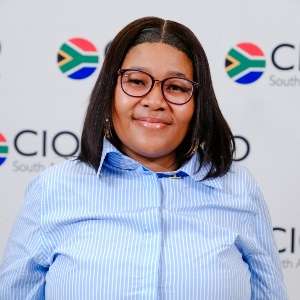

Philip Morris International CIO for sub-Saharan Africa Mary Mahuma is leading digital transformation with a focus on purpose, access and impact. She reflects on the values shaping her approach to leadership and technology.
Mary Mahuma has always known how to turn an opportunity into something real. Long before she became sub-Saharan Africa CIO for Philip Morris International (PMI) and won IT Project of the Year at the 2025 CIO Awards, she was a primary school girl using the bottle cap of a beer bottle to measure nuts to sell at school and charging the kids in her neighbourhood a small fee to watch her family’s black and white television.
“I just have an entrepreneurial mind,” she says, laughing at the memory. “And I am so happy that my kids have followed suit and are keen on pursuing entrepreneurial ventures with me.”
Asked who has been the most influential mentor in her life, she does not name a corporate executive or a professor. She speaks about her aunt, a woman living in rural Mokopane, Tshamahansi, who has spent her entire life running a drop-off centre for vulnerable children.
“We take care of about 235 children, feeding them in the mornings and evenings and helping them with homework after school. There are many child-headed households in our community, who either have a sick mother or grandmother – and my aunt and many other women who volunteer in the centre do their best to help them where they can,” Mary explains.
Her aunt has never held a corporate title or sought one but has continued to inspire how Mary chooses to show up. “She serves as a mentor within the community and solves real problems. I am so inspired by her passion for giving back.”
Serving others
Her aunt is a living philosophy that Mary has absorbed and made her own. The belief that leadership exists outside title and that purpose is not something you discover in a boardroom. That you are, as the Ubuntu principle holds, because other people are.
At home, her daughter often recruits her friends on weekends to make sandwiches for people experiencing homelessness in Cape Town, showcasing the deep impact Mary’s service has had on the people around her.
“That inspiration from my aunt has made me understand that leadership goes beyond just corporate. You need to be a servant. We are not here for our own purpose, our purpose is to serve others,” Mary reflects.
True to her entrepreneurial spirit, Mary runs an agro-processing company on weekends with her children. She dehydrates fruits and vegetables, preserving citrus for the off-season and turning produce into beetroot, spinach and butternut powders. It is a small business, but it carries a larger intention: reducing food waste while making seasonal flavours available year-round.
“I dehydrate blood oranges, grapefruit and other seasonal fruit that are not easy to find. You can enjoy them with your tea, bake with them or use them in salads,” she explains.
Turning tradition into business
The business stems from what she describes as “commercialising her childhood”.
“Food preservation has always been part of how we grew up, particularly in rural areas. We grew up drying meat and fish, milling our own maize and sun drying tomatoes and spinach. That is basically what I am doing now, it’s just fancier,” she says.
In her role at PMI, that same problem-solving instinct recently culminated in her winning IT Project of the Year at the 2025 CIO Awards for the organisation’s omnichannel order management project.
“The win is not for me but for my team. I am particularly proud of what this says about the ability to inspire and influence people to create something impactful. That is really humbling.”
The project was designed not with urban consumers in mind, but with spaza shops serving communities with limited infrastructure, safety challenges and unreliable access. The goal was to give retailers in underserved areas a simpler, more direct way to access information and place orders, while closing the gap between new product availability and the communities they serve.
There is a personal dimension here too for Mary, whose uncle passed away from lung cancer due to tobacco use. “We are trying to ‘unsmoke’ the world and get people to move to better, smoke-free alternatives and I can’t imagine how different things might have been if my uncle in Giyani would’ve been able to access these alternative products in time,” she says reflectively.
Leading transformation in a shifting landscape
Every time she builds a technological solution, she said she thinks of her aunt in a rural village where connectivity only recently arrived. “I always think about my aunt, who only started having access to high-speed internet recently. It’s about making sure that access is real, not just theoretical.”
Mary has been in the IT space for nearly 27 years, rising from IT support to sub-Saharan Africa CIO at PMI. She has also, in that time, never stopped studying. She is a qualified legal practitioner who also holds several IT qualifications and has completed an MBA essentials course, a digital marketing qualification and, most recently, an AI leadership course at Insead in Singapore. She described herself as someone who is deeply curious and genuinely does not know how to stop learning.
“Since I left matric, I have never stopped studying. I always say I am not doing anything this year, but there will always be something,” she says laughing.
As CIO, Mary is now two years into leading the AI transformation journey for PMI sub-Saharan Africa across the cluster. She speaks about it with a mixture of excitement and nervousness. “Agentic AI is something I am excited about but equally nervous about. I have not come to terms with the impact this will have on future generations.”
The nervousness is not paralysis. It is the kind of honest reckoning that makes her effective at the work. She has structured the transformation around two pillars: building AI literacy and confidence among employees, and finding real business problems that AI can help solve.
“The challenge about transforming your business is not that people do not adopt, it is internal resistance. Building confidence so that your people are not resistant to change is quite important.”
Balance, perspectives and purpose
In Africa specifically, she is navigating a more complex set of variables than her global counterparts. Infrastructure gaps, governance frameworks still catching up and markets that are at different stages of digital maturity.
“Africa is behind but we are making progress. We have a responsibility as leaders to bring this continent on par with the rest of the world for future generations,” she adds passionately.
Before she steps into the office each morning, Mary spends time in prayer and scripture, which she described as foundational to her day. “By the time I step into the office, I am already balanced and in high spirit.”
The rest of her balance comes from her two daughters – going to the gym together, playing padel or simply dancing around the house. She also has a standing commitment with them: at least twice a year, they travel somewhere together.
“Travelling shows them different perspectives and possibilities, so they become bigger dreamers. It also helps teach them gratitude, which is a core part of our belief system as a family,” she shares.
For Mary, success and a good life come from positively impacting someone else’s life. “Success is about that inner feeling of doing something excellent that changes a person’s life, even if it’s just one life, and for me, that is enough.”