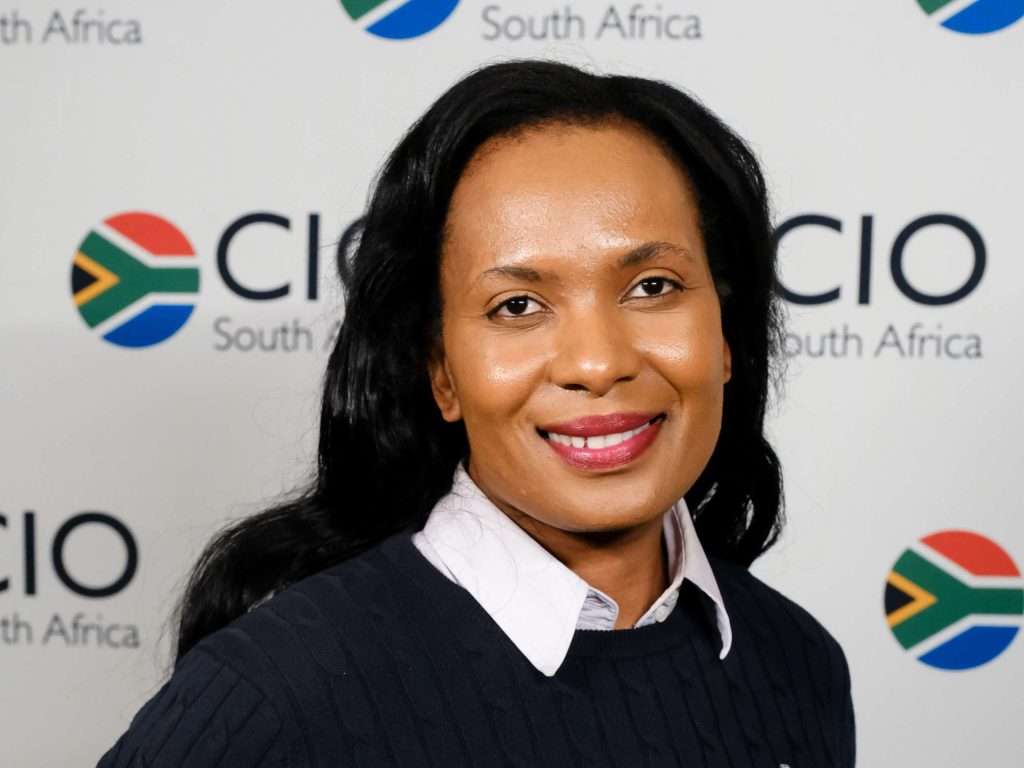
For RMB’s Engineering Centre CIO Emily Mbele, life has often meant navigating circumstances with careful calculation, a skill honed during her childhood in Soshanguve township. Here, many decisions were a response to the consequences weighed beforehand.
“When you grow up in a township, everything you do is a choice. When you wake up, you make a choice. When you leave the gates of your house, it is a choice. Every step until you get to school is a choice,” Emily reflects. “I made peace with my reality – that my parents wouldn’t be able to afford university – and I knew the only way to get out of the situation I was in was to choose differently.”
Emily initially considered familiar professions like medicine or teaching. It was only in high school, through a programme called ProTech that selected promising students, where she discovered computer science and engineering existed as career options. “It exposed me to things like computer science, electrical engineering, mechanical engineering and the fact that it was an actual career,” she says.
This led her to apply for bursaries in the tech industry, and she eventually secured one from Telkom for computer science. When acceptance letters arrived from both UCT and Wits, her mother insisted she take the opportunity at UCT.
Her upbringing taught her early lessons in resource management and responsibility which shaped her approach to technology leadership today. After completing her BSc in computer science and mathematics, Emily worked at Telkom as a test analyst. Her career trajectory was shaped by recognising and embracing opportunities across telecommunications (MTN and Neotel), consulting (IBM) and manufacturing (Gibela), before arriving in financial services at RMB.
Each industry transition required adaptation and rebuilding credibility. “When you move from telco into banking, it is two different worlds. When you move from manufacturing to banking, there are five other worlds,” she reflects.
In banking, for example, there are very clear lines of accountability and responsibility. “You have to think about things like regulation and security – every decision you make has to be factual,” Emily explains. In manufacturing, however, she points out that it is more of a shared responsibility between engineers. “By the time it gets out of your hands to go into the next step, it would have already been reviewed a hundred times, with everyone sharing suggestions for improvements or changes.”
In the telecommunications industry, you can use smoke and mirrors to hide failures. “The impact in banking is high and fast,” Emily explains. “One mistake could cost you your reputation. One unhappy customer could cost you millions.”
Maintaining and sustaining billion-rand networks
“There’s no experience that is not worth it,” she adds. As the engineering centre CIO at RMB, she oversees the infrastructure that powers the entire organisation and therefore together with her team, they have become the backbone of RMB’s systems.
Her portfolio encompasses everything from information and cybersecurity to integration technologies, reconciliation systems and the technological foundation supporting all business units. While line-of-business CIOs focus on client-facing innovations, Emily ensures the underlying infrastructure remains resilient.
RMB places strong emphasis on long-term decision-making. As Emily explains, “every decision we make today has the potential to shape our customers’ experiences for years to come. That is why we invest time in thorough analysis and research – to ensure we are implementing solutions that will stand the test of time and continue to deliver value.”
She adds that this is why many of the systems in the bank have been there for years, and are still running efficiently. However, the technology teams regularly introduce new tools to improve these systems’ efficiency, such as robotic process automation (RPA) and process engineering.
Considering the human being behind the technology
At RMB, Emily has championed transforming the bank’s cybersecurity culture, moving from a technical focus to a human-centred approach. “We can deal with the big things, like putting firewalls and perimeter protections in place, but the weakest link will always be the human being sitting behind the computer, or a mobile device with a link to the bank’s information,” she explains. “The reception ladies and the tea ladies leave their machines at the office, with weak or sometimes no passwords. That’s how attackers get to us and organisations don’t focus enough on training them.”
Rather than treating security as somebody else’s problem, her team has worked to make it everyone’s responsibility, from executives to reception staff. “Over the last four months, there’s been a lot of focus on changing the mindset and culture around cybersecurity. People see it as a barrier, but we’ve seen the mindset shift in people as they become more aware of little things, like not scanning every QR code you find in public and checking if Wi-Fi is secure before you connect,” Emily shares. RMB is also teaching employees how to encrypt and protect their data.
Her next area of focus is on developing women in technology. Emily leads the Women in Technology forum at RMB. She describes it as “not a coffee session or tea party” but a strategic initiative, with budget, programming and measurable outcomes. “We are intentional in how we are going to empower women,” she explains. The forum creates a support network where women can seek advice before making career-altering decisions.
Interestingly, most of her mentors have been men, something she’s working to change by actively mentoring both women and men herself. “We are building a pathway for the rest of the women. So you need to work three times harder and be okay with it, because you are not only doing it for you, but for the rest of the women in technology, too,” she adds.
Like many technology executives, Emily is always thinking about the future. “My aspiration is not to remain in tech,” she reveals, contemplating what lies beyond her current role.
Whatever that next chapter holds, it will undoubtedly be shaped by the same thoughtful decision-making that has defined her journey from Soshanguve to overseeing technology infrastructure that supports billions in daily transactions.
Looking back at challenges she has faced throughout her life and career, Emily reflects, “everything that happens, everything that you experience – however painful, and even if it feels like the end – just prepares you for something better.”