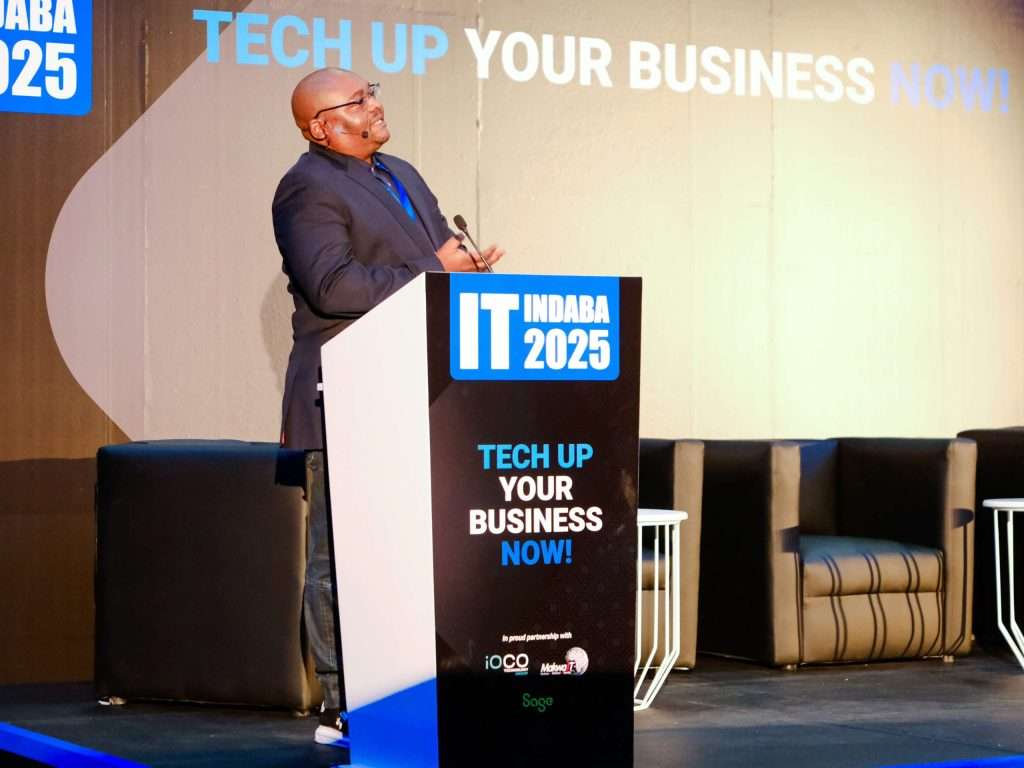
At the first-ever IT Indaba, Makwa IT’s BU lead Lesedi Modibane predicted that Africa’s next economic leap will come from platforms that focus on inclusivity. He called for apps designed around local realities.
Makwa IT BU lead Lesedi Modibane framed his 2025 IT Indaba address talk around three factors, the first being ecosystem thinking. Global tech leaders, he noted, started small and grew by embedding payments and other features. In his view, Africa needs to follow a similar model that links value chains rather than building in isolation.
“You cannot design a system or a platform and be siloed in your approach. If you augment your value chain with other stakeholders, there is a higher return that comes with that. You must make it easy to integrate and easy to use with open architecture as part of it. That is how platforms evolve into ecosystems,” he said.
The second force he touched on was data. Lesedi described what he termed the ‘data flywheel’, a continuous loop of learning from user behaviour to improve experiences and anticipate demand. He illustrated it with a simple example, saying a hotel could use guest data to prepare their favourite drink before they arrive.
“Every time there is interaction on a platform, it learns from the behaviour and usage patterns. It studies what the user did, what can be improved and what the next best option might be. If you know your customer, you can offer targeted offers instead of random sales calls,” he explained.
Focus on the customer
Lesedi also highlighted user experience, noting that today’s consumers prefer a single, seamless interface rather than switching between apps. He cited this as the reason why banks are integrating chatbots into messaging platforms and advised African developers to prioritise convenience.
“Be where the client is. Platforms need to evolve with customer preferences, behaviours and choices. Don’t make it difficult for me to consume your service. Make it as seamless, easy and fast as possible. Take my money before I change my mind.”
According to Lesedi, the rise of influencers and digital creators is a new economic layer that marketers and product developers can no longer ignore.
“Marketers and product people are using these platforms to reach audiences in ways traditional channels never could. If you do not understand it, do not dismiss it because that is where the attention now sits. It is part of the new marketplace,” he said.
Lesedi urged developers and businesses to build solutions for African users first, focusing on informal and semi-formal markets, which account for most of the continent’s activity.
“Partnerships matter because you cannot have all the capability yourself. If you do not have it, partner with someone who does. Community power ensures locals are part of the delivery, not just consumers. Those three principles will get us there quicker, better and sustainably,” he said.
As Lesedi sees it, innovators should think mobile-first and centre their solutions around the customer, using cloud, analytics and machine learning to drive scale. He advised attendees to ensure the continent’s digital transformation benefits everyone who uses a smartphone.
“People are clued up on mobile and know how to use it, so if you want to build platforms, start there. Employment will come from the consumers and the creators who use these digital platforms. That is how we rotate Africa to the next digital wave,” he said.