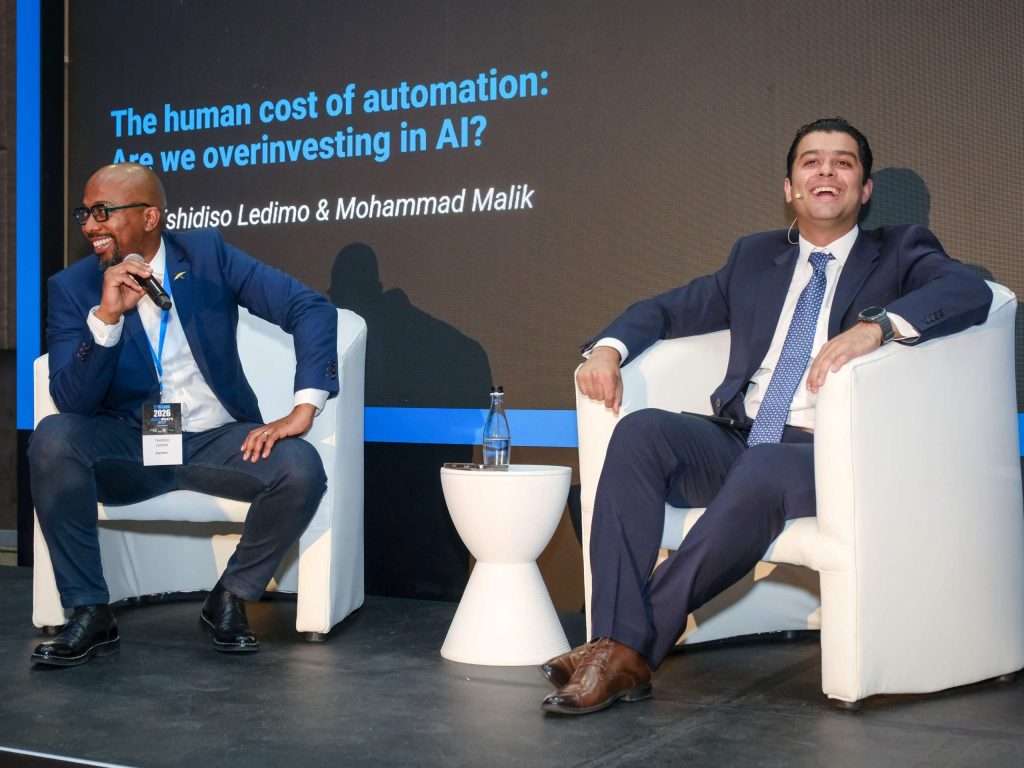
At the recent 2026 IT Indaba, tech leaders and corporate executives gathered at the Sandton Convention Centre for an impactful panel session titled The human cost of automation: Are we overinvesting in AI?
The discussion tackled corporate technology strategy, evaluating whether modern organisations are overinvesting in artificial intelligence without weighing true commercial value against broader social impacts. The panel featured key insights from Tshidiso Ledimo, group head: core platforms at Santam and Mohammad Malik, head of IT and enablement at Succession Financial Planning.
A primary theme of the session was the hidden financial expense of attempting to automate flawed offline processes. Organisations frequently face intense top-down pressure from executive boards to implement artificial intelligence, operating under the flawed assumption that automation inherently reduces operational costs.
Tshidiso illustrated this trap by sharing a call centre quality control case study where manual assessments initially cost R20,000 per month. After deploying automated AI models, the operational expense escalated dramatically to R50,000 per month due to tokenisation, consumption costs, and computational overhead.
“Any mistake that we make is thinking AI can solve all problems, but at what cost? The premise and the entry point should always be: what is the business case, and what are we trying to solve?” noted Tshidiso.
Mohammad reinforced this perspective, noting that technological experimentation must address core operational problems rather than automating simply because the technology exists. He cautioned against dedicating two weeks of engineering effort to automate a routine task that takes only one day manually.
Mohammad stated: “What is the challenge we are trying to resolve? Understand the challenge; this is the perfect example of digital transformation. If your process offline is flawed, forget about automating it or digitalising it in the first place.”
Social responsibility, governance, and workforce enablement
The panel emphasised that corporate automation decisions carry profound socio-economic implications, particularly within developing economies like South Africa. Replacing human workers with automated software systems disrupts broader community ecosystems, increases unemployment, and reduces household disposable income.
Tshidiso stressed that executive leaders must maintain a broader perspective beyond bottom-line financial metrics, recognising that call centre agents support multi-generational families and local township businesses.
“We have a social responsibility. As South Africans, we need to look and think deeper before jumping into wanting to automate, augment, or enable processes that will take the human out of it,” highlighted Tshidiso.
To prevent security risks and operational mistakes, Mohammad advocated for structured corporate governance combined with hands-on workforce training. He compared deploying advanced software tools without proper preparation to issuing hazardous industrial equipment without safety instructions.
“You are asking somebody to be responsible with using a nail gun, but you are not giving them the nail gun or the training along with it. Training and investing in the people becomes very important,” he explained.
Augmentation, cultural nuances, and preserving human potential
Rather than pursuing total job displacement, the speakers advocated for human augmentation, deploying technology to eliminate repetitive and time-consuming administrative tasks while preserving essential human relationships.
Mohammad shared how financial advisers utilise software tools to complete routine financial analyses in minutes rather than hours, allowing advisers to focus on client relationships and cultural context. “The human is still required for the relationship. As a financial adviser, I may use AI tools to improve efficiency in repeatable tasks, but to serve my client, I remain the face. This is where cultural nuances need to be understood, which AI cannot do by itself.”
Concurrently, employees must adopt a proactive mindset of continuous skill development to remain relevant alongside technological shifts. Tshidiso concluded that leaders must actively facilitate workforce upskilling while workers take personal responsibility for their career growth. “You cannot be in technology and not follow the simple guidelines of continuous learning. I call it learn, unlearn, and relearn. It is your responsibility to always empower yourself.”