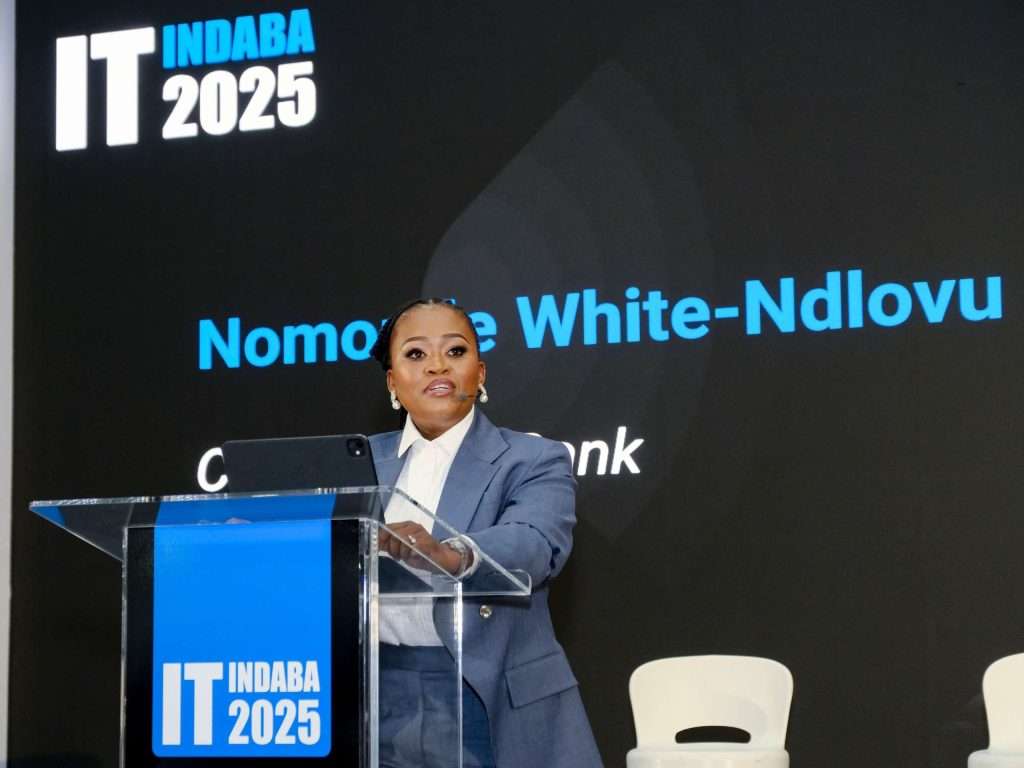
Bidvest Bank CIO Nomonde White-Ndlovu launched the 2025 IT Indaba with an impassioned keynote address, emphasising the need for CIOs to redefine their role, and be the architects of the future.
On 15 October thousands of IT professionals and tech influencers gathered at the Sandton Convention Centre for the inaugural IT Indaba, Africa’s largest IT conference and expo. With a dynamic programme covering everything from live demos to discussions about the new workplace reality, attendees readied themselves for a full day of thought leadership, expert insights and networking.
Nomonde kicked off the Indaba by welcoming attendees and acknowledging their survival of “the battlefield that is Sandton traffic on a weekday morning”. The theme of her address was The importance of redefining the role of the CIO and their seat at the table. In too many boardrooms, said Nomonde, the CIO is only invited to the table when there’s a crisis, a system outage, or compliance audit, but rarely when the strategy of the business is being designed.
“Yet every organisation today is digital at its core; how we unlock business growth and protect value is through technology. If the future of business is digital, then why is [the] CIO often still treated as an operator and not the architects of business? That story must change, and that change must start with all of us here today. The CIO of today and tomorrow is not simply an enabler of technology but we are builders of talent and architects of trust. Let’s reflect on how we create a meaningful seat at the table and use it to design the future,” she urged.
Nomonde emphasised that the world is asking new questions of leadership. “Just glance at headlines in South Africa; we’re a nation in transition – politically, economically, socially. Underneath that is a deeper conversation happening about trust, ethics, accountability, and systems that serve people, and those same questions are being asked of us,” she said.
According to Nomonde, every organisation and board agenda, whether acknowledged or not, is being shaped by four powerful sources: AI, cybersecurity, compliance and regulation, and customer trust. And every one of these aspects sits at heart of the CIO’s mandate as technology leaders.
Translating tech into business value and building talent
She also noted that in a country with high unemployment – and the highest inequality in the world – a CIO’s leadership decisions carry real-world consequences.
“The time is now. We can no longer afford to be on the margins; we belong at the centre of strategy. Let’s be clear: we don’t have to wait for an invitation to a seat at the table. We must have confidence and a clear voice in the intention of the future we are shaping.”
Nomonde highlighted that the board doesn’t care about servers or code, it cares about growth, risk, trust and business reputation – and this is why CIOs must “learn to translate technology into the language of value creation”.
“The modern CIO must be as fluent in strategy as they are in systems and code,” she emphasised.
Nomonde added that it's critical that CIOs are intentional in building and elevating talent, because talent is a multiplier and turns vision into execution. “Building talent is the work of leadership and mentorship changes the trajectory of lives. Sometimes, all someone needs is to be seen and believed in,” she said.
Building on from this, according to Nomonde, Africa’s young population is our greatest asset – and responsibility. For Nomonde, CIOs can’t only focus on today’s systems, it must also be on people. “We must create pipelines, mentor relentlessly, sponsor loudly, build cultures where innovation is celebrated, and where leadership isn’t measured by the code we build, but by how many people rose because of our actions.”
To close off her keynote, Nomonde urged attendees to take a message back to their organisations: “We must reframe compliance not as red tape but as customer investments; embed inclusion not as a side initiative but as infrastructure for innovation. The technology leader of the future is not a technologist waiting for a seat at the table, they are strategist who builds the table, sets the agenda, and brings the next generation along.”
She ended posing these pertinent questions: “Will you lead from the margins and guard your seat, or will you use it to build the future? Will we as leaders be the architects of that future, and be at the forefront of creating a future that all of us will be proud of?”