
Kuben Nair, CTO at Harambee Youth Employment Accelerator, once thought IT wasn’t for him. But his career path eventually brought him back to tech – this time with purpose: helping South African youth realise their potential.
“I grew up in Chatsworth and got distinctions, so everyone wanted me to be a doctor. But life had other plans,” says Kuben.
Medicine didn’t excite him the way technology and physics did, so he completed a BSc in both computer science and physics, at the then University of Natal. Kuben dreamt of working for NASA, but in his final undergraduate year his physics professor gave him sage advice: “Focus on computers if you want to make any money.”
He dropped the physics, did his honours and secured a spot on a Standard Bank graduate programme as a junior software developer. In 2004, he swapped Chatsworth for Johannesburg.
A year later, he realised he’d made a big mistake.
“I had to leave not just Standard Bank but tech completely. It was a deep and difficult realisation: IT in the working world wasn't for me.”
Finding a new way to work
Kuben was seriously worried he'd have to start over and study something else. Then a career consultant suggested consulting. She told him the field valued how he thought more than the degree he held.
He took her advice and joined McKinsey as a research analyst. The role introduced him to strategy, consulting and travel. It also challenged his assumptions about himself.
“I’d always thought I was a shy introvert and that working behind a screen gave me a reason not to talk to people,” he says. “The McKinsey role was client-facing and forced me out from behind the screen. I had to engage with people, which I enjoyed.”
Despite enjoying being a consultant, something was still missing. Before McKinsey, Kuben had always been involved with charity work. He trained as a youth peer counsellor with the Chatsworth Child and Family Welfare Society and served as an ambassador for the South African Down Syndrome Association. As his corporate career took over, all that fell away. He began wondering whether he could make a living doing something he found genuinely fulfilling.
“That’s when I stumbled upon the concept of social entrepreneurship,” says Kuben.
Building the skills to make a difference
A lightbulb went off, but Kuben wasn’t ready to make the leap. So, he decided to do an MBA to understand the different business functions he would need to master as a social entrepreneur.
“My career moves after that were all about building the confidence and skills to become a social entrepreneur: strategy, building teams and managing people. Then, when I landed a role as strategic marketing manager for Castle Lite at SABMiller, it ticked all those boxes.”
When AB InBev acquired SABMiller, Kuben accepted a voluntary severance package. In hindsight, being laid off gave him the perfect opportunity to spend a gap year working with youth organisations, so he could learn as much as he could before starting his own venture, which he thought would be in education.
During that year, he crossed paths with Harambee’s then CEO, Maryana Iskander. “She blew me away with Harambee’s vision. I met the teams and loved the culture,” he says. “She told me that instead of starting from scratch, I could achieve far more by joining Harambee and working with its existing resources and partnerships.”
That was nine years ago. Kuben started close to Harambee’s candidate-facing operations, and when the organisation began using technology to scale in 2018, he took ownership of the product as part of the youth experience. Over time, as CTO he brought product and platform together into the youth hiring platform SA Youth, which now supports almost 5 million youth and helped pathway them to over 2.4 million work opportunities.
Making hidden potential visible
“Before Harambee, I moved jobs every three years. I never thought I’d stay this long, but I am home. It’s the fulfilment and purpose I’ve always wanted.”
One experience during his first month at Harambee helped crystallise that purpose. Kuben took part in mock interviews designed to prepare young jobseekers for the workplace. One of them was a young woman named Palesa.
“I asked the usual interview questions. She lowered her head and said she couldn’t answer them because she had never worked before. Then she handed me a blank CV with only her personal details and matric marks.”
Kuben asked what she had done to get by after school. Palesa told him she had saved some grant money, bought cosmetics in bulk from a wholesaler, repackaged them into smaller quantities and sold them to people in her community. She later began offering make-up services and advice.
“I realised she could answer the questions; she had so much capability. The problem was that the traditional hiring process didn’t cater to ‘hustles’. That inspired me and my team to build the SA Youth platform that makes that potential visible to employers across the country.”
For Kuben, tackling youth unemployment requires collaboration at scale. He notes that Harambee is working with the Presidency and business associations on a joint plan to reduce youth unemployment nationally.
“We’ve tested it with economists; we can do this,” he says. “We see stories of hope and success all the time, but those don’t always make the news. Now it’s about working together and getting it done.”
Leadership without the ivory tower
Kuben describes himself as a servant leader, something he discovered about himself in his first management role at SABMiller.
A few months in, he started hating it and he questioned whether he was cut out to be a manager. Then a new general manager arrived and introduced him to authentic leadership.
“I realised I’d been modelling myself on my previous boss, who had an authoritative style. That wasn’t my nature; I hated pretending to be someone I wasn’t,” he says. “My new boss helped me identify a leadership style that was true to my values and personality. She gave me permission to shape the way I wanted to lead.”
At Harambee, Kuben sees his CTO role as helping create the conditions for teams to thrive. “I support from the top, the middle and the back. I buffer from the top so people can focus on what’s most important, not taking up space in an ivory tower. I walk beside my people, accessible and in the trenches; I back them from behind, people who are smarter than me to lead and drive.”
Slowing down what matters
In his downtime, Kuben loves to travel – he tries to see a new country and experience a new culture every year. This year’s destination, Japan, had to be cancelled due to geopolitical tensions, but Finland’s Northern Lights and Singapore’s Grand Prix are still on the table.
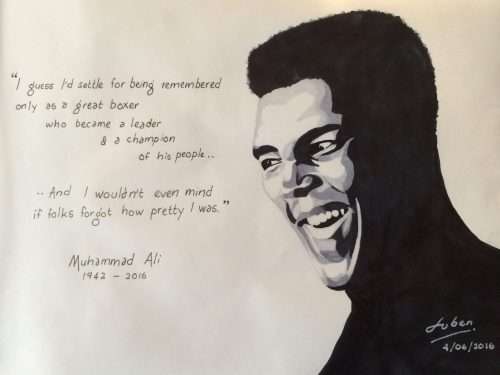
Kuben is also a keen mindfulness practitioner, avid fantasy reader and regular sketcher. “Overthinking is a problem for me, so I sketch from the heart. After a few hours of mindfulness meditation, I’ll sketch whatever I'm feeling.” He also enjoys a good ‘90s slow-jams playlist and learning about agentic AI.