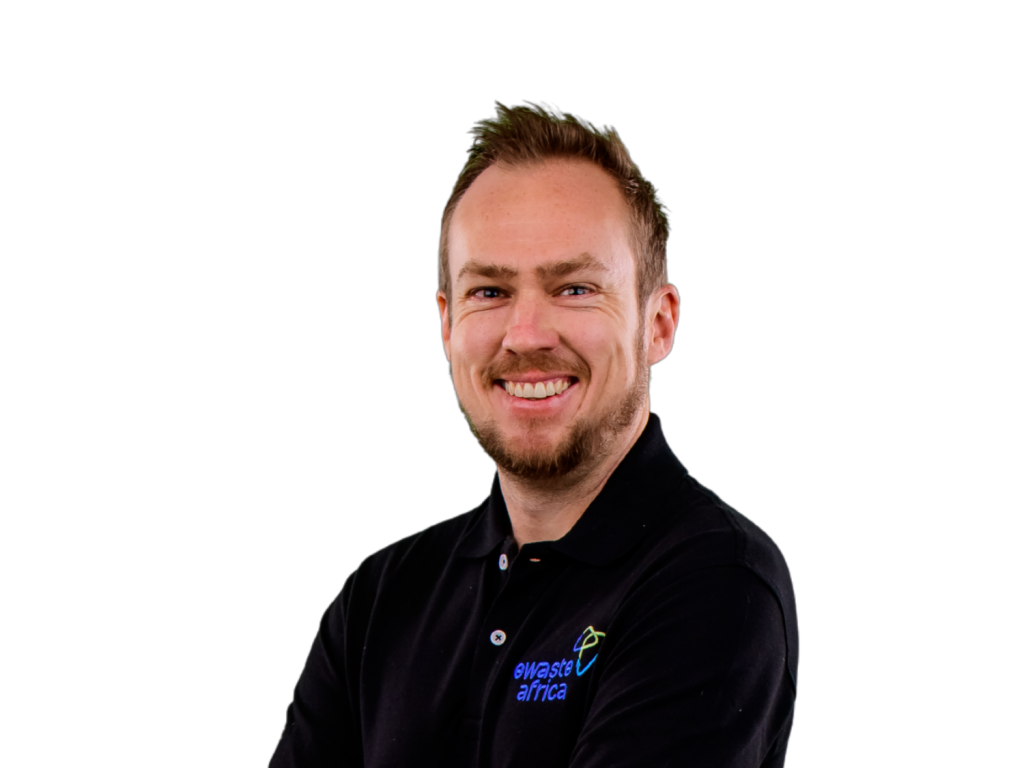
Mark Williams-Wynn didn’t plan for a career in e-waste recycling. Today, as CTO of EWaste Africa, he's combining engineering, AI, and innovation to help tackle one of South Africa's fastest-growing environmental challenges.
E-waste, or electronic waste, is any unwanted or broken electrical or electronic device that has reached the end of its life. It’s also a huge problem, globally and locally.
According to the United Nations Institute for Training and Research (UNITAR), global e-waste will reach a record 82 million metric tonnes by 2030. In South Africa, less than 10 percent is recycled, compared with recycling rates of up to 50 percent in the European Union (EU).
"The EU has had formal e-waste recycling systems for almost 20 years, so they're well ahead of the rest of the world,” says Mark. “Whereas in South Africa, Extended Producer Responsibility (EPR) regulations only came into play about five years ago.”
Today, Mark is helping shape how South Africa tackles one of its fastest-growing waste streams. But his route to becoming EWaste Africa CTO wasn't linear. Instead, it began with a PhD research project that slowly led him into the world of e-waste recycling.
An unexpected route into e-waste
While completing his PhD in Chemical Engineering at the University of KwaZulu-Natal (UKZN), he worked with university researchers on a project extracting rare-earth materials from lighting waste.
"That technology was patented and licensed to EWaste Africa, a leading South African e-waste and lighting recycler, so I joined the recycler to help with that operation’s processes. It started as one day a week supporting EWaste Africa’s rare-earth recycling plant before I slowly transitioned to a full-time role in 2019."
Mark says he was always interested in taking things apart and putting them back together.
“I built my own computer when I was young, and I loved fixing devices. So, I studied chemical engineering at UKZN, ended up doing my masters, then my PhD. To be honest, I wasn't convinced I needed to do a PhD – which is why I spent nine months as a researcher before committing. In hindsight, I'm glad I did it; I learnt a lot that helped me get to where I am now.”
A role beyond traditional IT
Although his title is CTO, Mark's role extends beyond traditional IT. “There are so many processes involved in e-waste recycling, from physical dismantling to mechanical and chemical processing, to extracting the final raw materials. When you study engineering, one of the key things you're taught is how to teach yourself to do something. You can't know everything as an engineer; you know how to do the research and figure out how to do something – being a CTO is similar.”
His career has progressed steadily from R&D engineer to CTO and member of EWaste Africa's advisory board. He was recently elected chairperson of the KwaZulu-Natal branch of the Institute of Waste Management of Southern Africa (IWMSA) and has chaired sessions and moderated panel discussions at international e-waste conferences.
As CTO, one of Mark’s biggest challenges is deploying new AI-based developments within existing processes. “We want to use AI so it creates space for people to do more, for example allowing our sales team to network more, and operations to spend less time reporting. It’s a challenge to find that balance between burying your head in the sand and spending more money on AI than people to do the same work.”
Looking back, there's one thing he wishes he'd known before becoming CTO: "I'd tell myself to expect far more meetings and replying to emails than I imagined!" And his advice for aspiring CTOs is simple: build a strong professional network. "I've met people at conferences who, years later, have helped solve problems we were facing. In an industry as broad as e-waste, having the right people to call is invaluable."
Making e-waste recycling easier for South Africans
Mark believes many South Africans still don't know how or where to recycle e-waste, so it often ends up in household rubbish.
To make recycling more accessible, EWaste Africa has established community drop-off points at selected Pick n Pay stores, some Checkers outlets (which take small items like batteries and disposable vapes due to container space restrictions), and several large businesses where employees can recycle their e-waste.
"Together, these collection points have diverted several hundred tonnes of e-waste from landfills. We currently have around 200 collection points nationwide, and our goal is to grow that to 1,000 by 2030."
The company is also exploring AI-powered cameras inside collection containers to monitor bin capacity levels and improve collection routes, reducing unnecessary trips.
An analogue life outside the office
With two boys under three, Mark laughs that holidays are no longer about relaxing with a book. His family also has a strict no-screen policy for youngsters – and the adults.
"My wife is a paediatrician, so she keeps up with the latest early childhood development research. The evidence is very clear: children under two shouldn't have any screen time, and older children should only have limited exposure. We also try not to use our phones when we're with the boys. If we need to respond to a message, we try to leave the room. We want them to learn how to entertain themselves without screens."
Mark is an avid amateur photographer, and before the boys came along, he spent a lot of time taking landscape and wildlife photos with a DSLR camera. “Unfortunately, my cameras don't get used as much as I'd like but hopefully, I'll use them more once the boys get a bit older.”
He knows that every father is biased, but he thinks his children are the “cleverest boys”. “My three-year-old already wants to learn how to read and he'll ask us philosophical questions we really have to think about! I think he might become an engineer because he wants to know how everything works. He asked my wife the other day, ‘How does an escalator work?' She replied, ‘Ask your dad!’.”