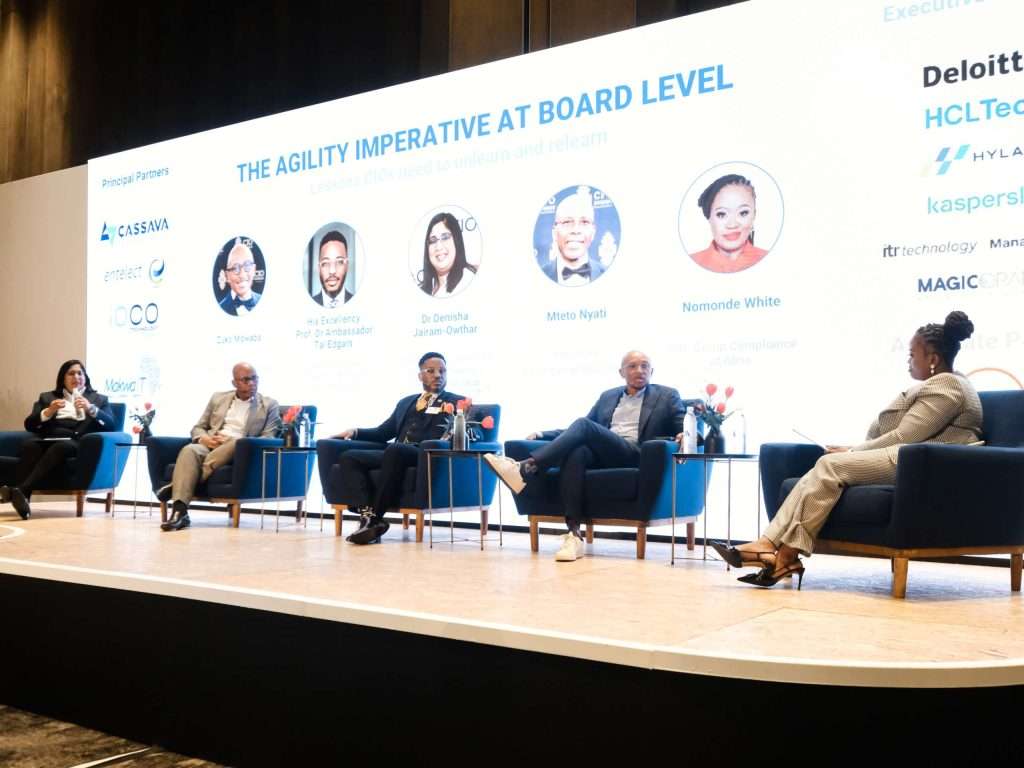
During the recent CIO Day held in Johannesburg, IT executives identified the real “agility imperative” as more human, reflective and structurally adaptive leadership.
High level executives such as Dr Denisha Jairam-Owthar, group CIO, Council for Medical Schemes; Nomonde White, chief information officer of group compliance at Absa Group; Zuko Mdwaba, Xponential Group CEO; His Excellency Prof. Dr Ambassador Tal Edgars, group executive chairman, GBSH Consult Group, and BSG executive chairman Mteto Nyati explored how governance and technology are affecting company operations at the event.
Despite unprecedented investment in digital transformation, many organisations remain structurally slow, culturally resistant and strategically fragile.
In boardrooms across every sector, the same pattern is playing out. Organisations are investing heavily in cloud, AI, automation and digital transformation, but still find themselves stuck in slow decision cycles, risk‑averse cultures and fatigued leadership teams.
“We often speak about agility as though it is primarily a technology challenge, but if we are honest, technology isn’t really the thing slowing organisations down. Leadership, governance, decision making and institutional inertia is. Because while technology is moving exponentially, many organisations are still attempting to respond through structures, leadership models and governance approaches designed for a fundamentally different era,” said Nomonde.
She challenged the notion that organisations needed to be more agile, saying perhaps the deeper question should be around leadership structures being emotionally and operationally capable of moving at the speed modern complexity now demands.
The executives were clear that the question facing boards and CFOs has shifted from “Are we investing enough in technology?” to, “Are we leading in a way that allows technology and our people to actually change the organisation?”
20th-century governance vs Fifth Industrial Revolution pace
Modern technology is operating at a daily cadence, but most boards still move on a quarterly basis. CIOs are saying that misalignment presents an architectural issue as opposed to a technical one.
While boards remain anchored in 20th‑century governance designs built for predictability and control, technology is operating in a 21st‑century context defined by volatility, interdependence and non‑linear change. The result is a widening gap between what is technically possible and what is organisationally permitted.
“Leaders and the boards, particularly, are afraid to say I don’t know. I find that when we aren’t able to say that, we haven’t reached a point where we can actually solve problems together. And normally the experiences I’ve had, boards on the back foot with technology, because technology doesn’t wait for legislation, governance or King V,” said Denisha.
AI and digital initiatives are being pushed into “pilot purgatory” while competitors industrialise similar capabilities.
“In mis‑leadership, we operate in the same way we have operated for the last 20 years. Leadership is a concern for us now, saying, how do we change the narrative to spin it enough for the organisation to handle what is going to come. There is that psychological narrative that boards have, that there is the compliance checklist and everything else, and now you have agentic AI that are moving so fluently. If we don't catch on very quickly, we will be stuck in this box that we’ve created called governance,” Prof. Tal warned.
Where transformation really fails
CIOs say they are accustomed to being blamed when transformation stalls because of aging systems or complex data. They’re also finding that evolving technology is giving rise to a skills scarcity, building newer skill sets at the pace technology is evolving.
But when you look closely at failed or fatigued transformations, a different pattern emerges.
“The reality is we’ve always talked about the importance of culture in organisations, but culture ends up being the very thing that people end up hiding behind, because the culture that’s created in [an] organisation inhibits the progress in terms of transformation,” Zuko explained.
Publicly, organisations celebrate innovation. Internally, they reward caution, hierarchy and consensus. Formal and informal incentive structures from KPIs to promotion criteria continue to signal that risk‑taking is dangerous and “not breaking anything” is safer than learning fast.
“You know, if there’s a certain behaviour that’s been created from a board level, right up to the leadership, if the incentives are as a result of a KPI that you measured on, what it tends to do is that it influences the behaviour of people.”
The real fault line
From the CIO’s perspective, no amount of new architecture can compensate for misaligned incentives. While most boards can sense enthusiasm at the top and bottom of the organisation: executives want competitive advantage and younger employees want modern tools, flexibility and impact. But there is a structural fault line at middle management.
“People who are actually operating as managers, we call those people leaders when, in reality, they are managers. And indeed you have many managers that are challenged with change. In many organisations you’ll typically find those at a middle management layer…you’ve got this layer that resists change, that is fearing change,” said Mteto.
From a CIO’s vantage point, this is typically where digital programmes stall simply because the human cost of change has not been acknowledged, answered or shared.
“The people that actually have the influence in the organisation, When you take those influencers, when you lift that corporate veil off that structure, that’s where you will get either the drivers, the resistors or the fence‑sitters of change. Find the people who can influence and use them as your change advocates for technology in the organisation,” said Denisha.