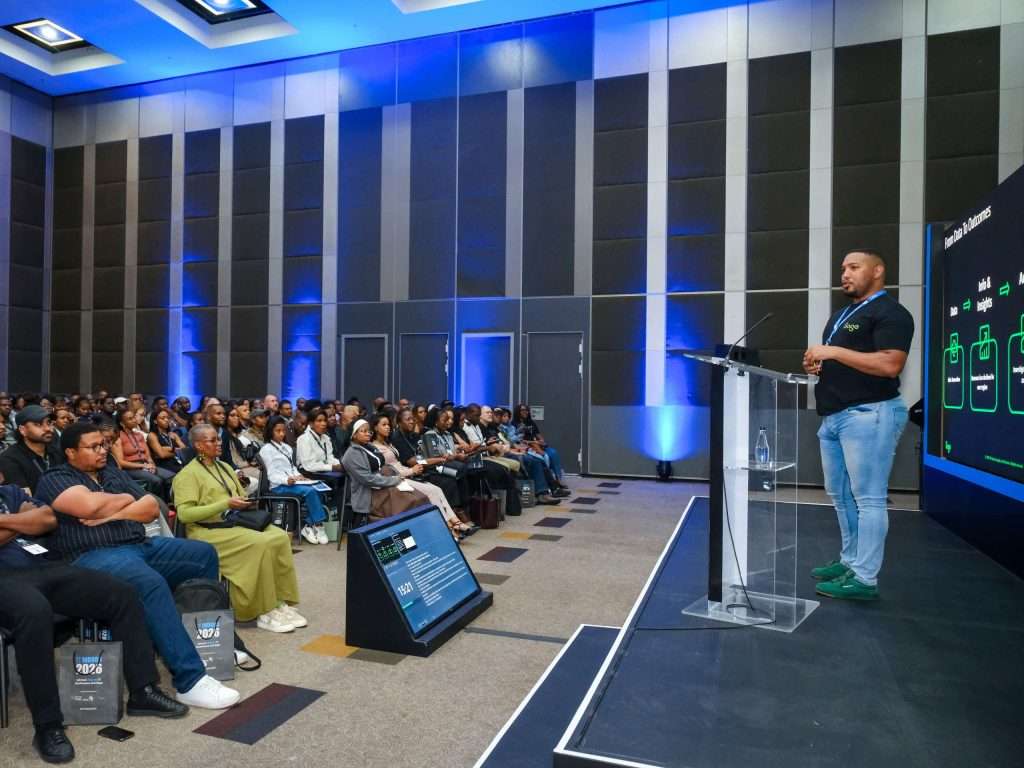
Businesses do not necessarily need more data to improve performance, but better ways to interpret and use the information they already have. Speaking at the 2026 IT Indaba, Radlin Wagner, senior practice success specialist at Sage, highlighted how integration, automation and AI can help organisations turn data into actionable insights.
Businesses are collecting more data than ever, but fragmented systems and manual processes can make it difficult for decision-makers to access the information they need when they need it.
Radlin Wagner, senior practice success specialist at Sage, addressed this challenge at the 2026 IT Indaba, hosted at the Sandton Convention Centre in Johannesburg. He argued that the value of data lies not in how much an organisation collects, but in how effectively it uses that information to make decisions.
“Having data in a business and being data-driven are two completely different things,” he said.
He explained that as organisations grow, their technology environments often become more complex. Finance may operate on one system, human resources and payroll on another, while sales and operations rely on their own applications. Although each system serves a purpose, the information they hold may remain fragmented across the business.
This, he added, can make it difficult for management to answer fundamental questions about profitability, customers, operational performance and risk.
“The business became more connected than its information and this is because of the challenges facing organisations that expand their operations without ensuring that their data is accessible across departments,” he said.
The risk of relying on manual processes
Radlin illustrated the challenge through the example of a growing business that had accumulated multiple systems and increasingly complex data. Despite having more information available, management struggled to obtain straightforward answers to business questions.
In many organisations, he said, employees compensate for these gaps by manually gathering information from different applications, copying figures into spreadsheets, reconciling numbers and preparing reports for management.
He described this through the example of an employee he called “David”, who knows where information is stored, which spreadsheet contains the latest figures and which reports management should use.
While this employee may help the business function, relying on an individual to bridge information gaps creates a dependency and can leave the organisation vulnerable when that person is unavailable or leaves.
“What David was becoming was effectively an integration layer within the business. And when a person becomes a connection between all of the systems that are in your business, that’s not integration. That’s dependency,” he said.
For Radlin, the solution is to reduce the manual effort required to collect and reconcile information, allowing employees to focus on interpreting data and supporting business decisions.
He said organisations should prioritise improving the speed and quality of decision-making rather than simply adding more dashboards or collecting more information.
Turning information into action
Radlin outlined a progression from data to information, insights, action and, ultimately, outcomes.
Using the example of a business experiencing declining revenue from a particular product, he explained that transaction records represent the data. Organising those records to identify a revenue decline produces information, while determining where the decline is concentrated helps the business develop insights.
The next step is to investigate the cause and respond before the problem results in further losses.
“Data by itself doesn’t create value.The value comes from when the information changes what somebody does next,” he said.
This requires businesses to make relevant information available quickly enough for management to act. Reports that explain what happened in the past remain useful, but they may not provide the timely insight needed to address emerging risks or take advantage of opportunities.
Radlin said organisations can improve their response times by bringing together relevant information from across the business, giving decision-makers a more complete view of performance.
Three priorities for finance teams
He highlighted Sage's ecosystem approach as one way to help businesses address fragmented information, enabling applications to exchange relevant data rather than operate in isolation.
In the finance function, he identified three priorities: automating financial processes, analysing performance across multiple dimensions and synchronising data with other systems.
He summarised these priorities as “see more, do less and connect more” and seeing more means giving decision-makers a deeper understanding of business performance. Rather than knowing only that a business generated R10 million in revenue, for example, management should be able to examine which customers, regions, products, projects and departments contributed to that result.
“This additional context can help leaders identify where performance is strongest, where improvements may be needed and where opportunities exist. Doing less refers to reducing repetitive manual work so that skilled finance professionals can spend more time interpreting results and advising the business,” he said.
Radlin encouraged organisations to understand their existing processes, simplify them where possible and automate repeatable tasks.
“If someone spends most of their morning assembling information, then at which point do we start telling the story?” he asked.
Connecting more means ensuring that financial information can be considered alongside data from other parts of the organisation. Customer information, employee data and operational activity all contribute to business decisions, even when those records are held in separate applications.
Radlin referred to Sage Intacct Financials alongside planning, revenue and payroll applications as an example of how a broader view of business information can help finance teams understand performance in context.
AI needs a strong data foundation
He also addressed the role of AI, cautioning against making it the starting point of every data strategy.
Instead, he argued that organisations should first understand the business problem they are trying to solve, the processes involved and the information required to improve decision-making.
“We need to think about the information. We need to think about the process. We need to think about the connection, and we need to think about the decisions that we’re trying to improve in the business,” he said.
Once these foundations are in place, AI and automation can help businesses work more efficiently and respond to emerging issues sooner.
Radlin said Sage's automation approach aims to support faster financial closes, improve efficiency, save time, identify opportunities and help businesses address problems earlier.
The objective, he explained, is not to introduce AI for its own sake, but to use technology to help organisations make better decisions.
He described the technology environment businesses should aim for as connected, intelligent, open and scalable. Systems need to exchange information efficiently, support automation and timely insights, accommodate third-party applications through APIs, and evolve as business requirements change.
“For CIOs and technology leaders, this means evaluating technology not only on the capabilities of individual applications, but also on how effectively they support wider business objectives,” he said.