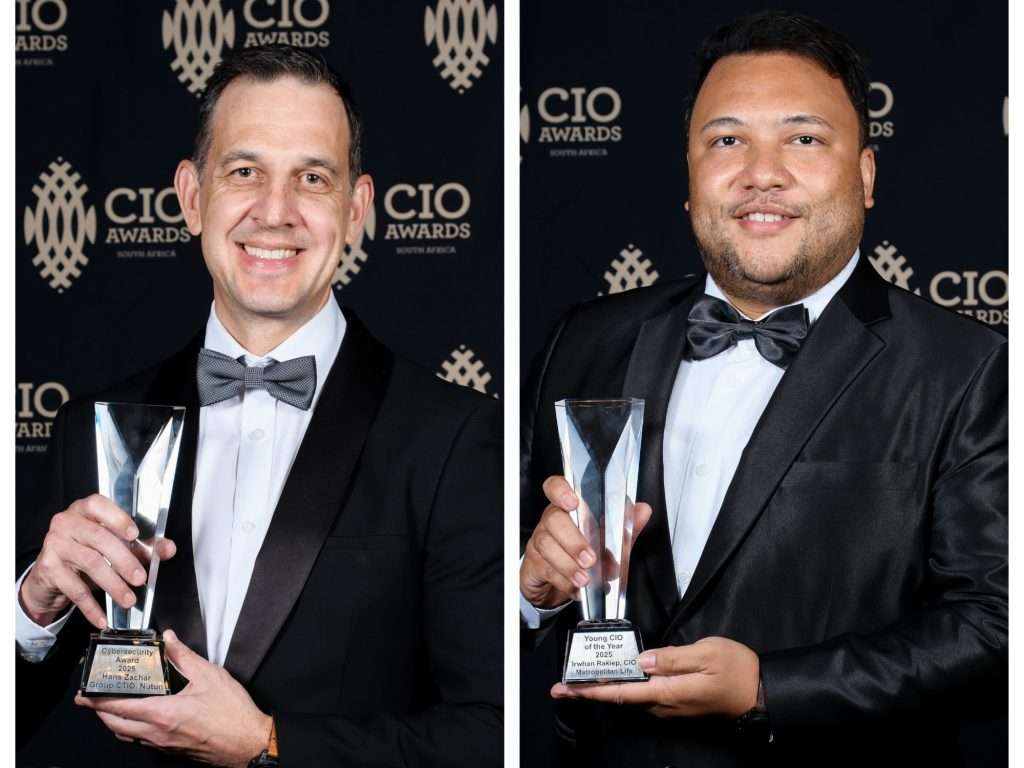
The 2025 CIO Award winners share the leadership lessons shaped by a year of uncertainty and rapid change. From agility and authenticity to timing and composure under pressure, Irwhan Rakiep and Hans Zachar outline the practical principles that guided their IT leadership in 2025.
As South Africa’s technology leaders navigate another year shaped by volatility, economic pressure and rapid innovation, CIOs are refining the leadership principles that guide how they lead their organisations.
Speaking to CIO South Africa, 2025 CIO Award winners Irwhan Rakiep and Hans Zachar reflected on the practical lessons that have emerged from operating at the coalface of technology and business change. Their insights point to a common theme for 2025: leadership is less about certainty and control, and more about judgement, timing and trust.
Irwhan Rakiep, Metropolitan Life CIO and 2025 Young CIO of the Year
For Irwhan, the past year has reinforced five core principles that continue to shape his leadership approach. He details them below:
Agility is the new stability
Irwhan notes that continuous change has reshaped expectations of technology leadership. “Change is constant and what works today may not work tomorrow,” he explains. As a result, he believes CIOs must create cultures that embrace change and encourage experimentation, enabling teams to move with speed as conditions shift.
Stepping up even in uncertainty
Irwhan reiterates that acting without perfect clarity has become unavoidable. “Leadership often means being able to see around corners and making decisions without all the answers.” Rather than waiting for certainty, he says CIOs need to rely on pattern recognition and informed judgement, maintaining forward momentum instead of “standing still”.
Getting the right people on the bus
Referencing Jim Collins’s well known concept of ‘First Who, Then What’, Irwhan reinforces the importance of team composition. He believes organisations perform best when they have “the right people in the right roles”, noting that execution quality, resilience and pace depend on ensuring talent is aligned with organisational needs.
Staying the course when others panic
Irwhan highlights moments of crisis as the clearest tests of leadership. Using an aviation analogy, he explains that although modern aircraft can take off, fly and land autonomously, “the role of the pilot is actually to step in when things are not going well”.
In the same way, technology leaders must maintain composure when teams feel overwhelmed. “Even when everybody’s panicking and it feels like everything’s on fire, you must centre yourself and refocus your teams on the bigger picture,” he adds.
Leading with authenticity
Authenticity remains central to Irwhan’s leadership approach. He notes that genuine relationships allow for constructive tension without damaging trust. “You can have a tough conversation without breaking down the relationship, because teams understand that criticism is not personal.” He adds that leaders continue to achieve more through connection rather than coercion, observing that you can get more done with a carrot rather than a stick.
Hans Zachar, Group CTIO at Nutun and 2025 Cybersecurity Award winner
Hans Zachar’s most significant leadership lesson from 2025 centres on timing and alignment with organisational cycles.
Reflecting on the year, Hans explains: “Businesses go through cycles, sometimes you’re growing and other times you’re going through consolidation. As CIOs, we must be able to recognise where the organisation is and adapt our posture accordingly. When you’re growing, you need to be investing. When you’re consolidating, you need to be moderating.”
Hans cautions against swimming against the stream of the business cycle, noting that the success of his organisation’s IT strategy has largely come down to getting the timing right.
Together, these lessons reflect a grounded leadership playbook for CIOs in 2025, shaped by uncertainty, operational pressure and the need to align technology leadership closely with business reality.